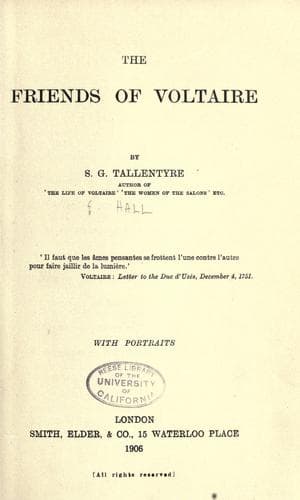
France -- Biography; Voltaire, 1694-1778 -- Friends and associates
But in the knowledge that he had brought ruin and disgrace on what he
loved best in the world, Condorcet sounded one of the great deeps of
human suffering. As the wife of an outlaw, Madame de Condorcet was not
only penniless, but could not even sleep in the capital. Wholly
dependent on her was her little girl of three years old, a young sister,
and an old governess. She was herself still young and brought up in a
class unused to work, in the sense of work to make money, for
generations. But there was in her soul the great courage of a great
love. The talents which had once charmed her _salon_ she now turned to a
means of livelihood. When her house at Auteuil was invaded by Republican
soldiers, Madame softened their hearts and earned a pittance by taking
their portraits. Twice a week, disguised as a peasant, she came on foot
from Auteuil to Paris, passed through the gates with the fierce crowds
thronging to the executions in the Place de la Révolution, and by
painting miniatures of the condemned in the prisons, of proscribed men
lying hidden in strange retreats, or of middle-class citizens, made
enough to support her little household. Then, sometimes, she would creep
to the Rue Servandoni, and for a few minutes forget parting, death, and
the terrors of the unknown future, in her husband’s arms. He might well
write, as he did write but a little while before he died, that even then
he was not all unhappy--he had served his country and had had her heart.
He spent the long days of his hiding almost entirely in writing. He
began by an exposition of his principles and conduct during the
Revolution, and gave an account of his whole public career. He was
writing it when, on October 3, 1793, he was tried, in his absence,
before the Revolutionary Tribunal, with Vergniaud, Brissot, and others,
accused of conspiring against the unity of the Republic, declared an
emigrant, and condemned to death.
On the 31st of the same month came the fall of the Girondins. Though not
himself a Girondin they had been once his friends, and in their ruin he
saw the immediate presage of his own; and his own meant that also of
Madame Vernet. He went to her at once. ‘The law is clear; if I am
discovered here you will die as I shall. I am _hors la loi_; I cannot
remain here longer. She answered that though he might be _hors la loi_
he was not outside the law of humanity; and bade him stay where he was.
Public-domain text, read in full here on John Shaqi.
Reviews
Reviews
No reviews yet
Be the first to share your thoughts on this work.
Elsewhere in the archive
Join the Discussion
Join the discussion
Sign in to leave a comment or review.
Sign InorCreate an account