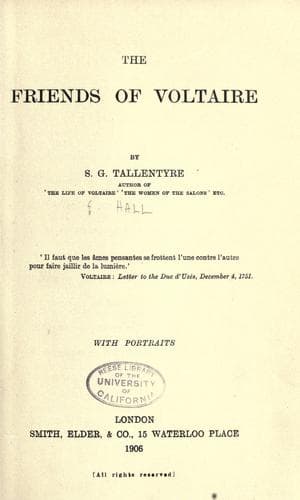
France -- Biography; Voltaire, 1694-1778 -- Friends and associates
His wife, in her peasant’s dress, came to him then for one of those
brief moments, stolen from Heaven. She knew him well. That
‘Justification’ of his conduct, his Apologia, that looking back on deeds
and sacrifices meant to bring the Golden Age to men and which _had_
brought, or so it seemed, the hell of the Terror--this was no fit work
for him now. Look ahead! Look on to that new country which your pure
patriotism and your self-devotion,--ay, and this Terror itself--shall
have helped to make--that warless world of equal rights and ever
widening knowledge, the beautiful dream of a sinless and sorrowless
earth, which may yet be realised, in part.
On the manuscript of the ‘Justification’ there is written in her hand
‘_Left at my request to write the History of the Progress of the Human
Mind_.’
In the very shadow of death, Condorcet told the story of men’s advance
toward life, of the evolution of their understanding from the earliest
times until now. Calm, just, and serene, with not an intemperate line,
not an angry thought, the ‘Progress’ reads as if it had been written by
some tranquil philosopher who had seen his plan for man’s redemption
adopted, and had received for his labour honours, peace, and competence.
Its fault, indeed, is its too sanguine idealism. Condorcet, like many
enthusiasts, thought his own way of salvation for man the only way; he
believed his own magnificent dream to be the only possible Utopia.
Beneath the guillotine and in social convulsions for which history has
no parallel, he looked through and past them, in that last great
chapter, in the exalted spirit of noble prophecy, to that Golden Age
which _must_ surely come!
But ‘The Progress of the Human Mind’ is something more than a splendid
hope, more than the greatest and most famous of its author’s works. It
bears highest testimony to the character of him who in the supreme hour
of his individual life could thus forget himself, and in the midst of
personal ruin, foresee with exultant joy the salvation of the race.
It remains for ever among the masterpieces which men cannot afford to
forget.
During his hiding Condorcet also wrote ‘The Letter of Junius to William
Pitt’ in which he expresses his aversion to Pitt, and an essay, never
printed, ‘On the Physical Degradation of the Royal Races.’ He also
planned a universal philosophical language.
In December, 1793, he wrote ‘The Letter of a Polish Exile in Siberia to
his Wife’--a poem in which another exile bade farewell to the woman he
loved.
The death-shadows were creeping closer now.
Public-domain text, read in full here on John Shaqi.
Reviews
Reviews
No reviews yet
Be the first to share your thoughts on this work.
Elsewhere in the archive
Join the Discussion
Join the discussion
Sign in to leave a comment or review.
Sign InorCreate an account