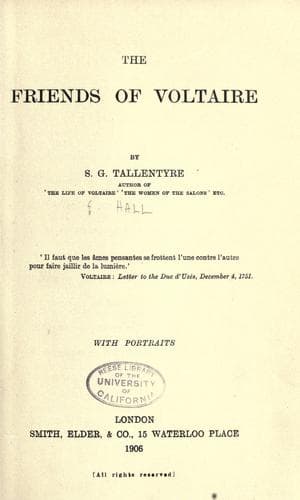
France -- Biography; Voltaire, 1694-1778 -- Friends and associates
But the writer was consumed to the soul with grief and weariness. This
was not the man who could use sorrow as a spur to new endeavour and to
nobler work. Before the persecutions which had assailed the Encyclopædia
he had bowed his head and taken covert, and the death of his mistress
broke not only his heart, but his spirit and his life. From Madame
Marmontel and from Thomas, he derived, it is said, some sort of comfort:
Condorcet was as a son; but with Mademoiselle’s death the light of her
society had gone out. The friends who remained were but pale stars in a
dark sky. D’Alembert was growing old. He suffered from a cruel disease
and could not face the horrors of the operation which might have
relieved it. ‘Those are fortunate who have courage,’ said he; ‘for
myself, I have none.’ It was life, not death, he dreaded. What use then
to suffer only to prolong suffering?
The mental enlightenment he had given the world, the wider knowledge
which he had lived to impart, consoled this dying thinker scarcely at
all. He was to his last hour what he had been when Mademoiselle took
ill-fated compassion on his dependence and loneliness--a child,
affectionate, solitary, tractable, with the great mind always weighed
down by the supersensitiveness of a child’s heart and with a child’s
clinging need of care and tenderness. He died on October 29, 1783.
The man whose only reason for dreading poverty had been lest he should
be forced to reduce his charities, left, as might have been expected, a
very small fortune. Condorcet was his residuary legatee, and made his
_éloge_ in both the Academies.
Diderot himself was dying when he heard of his old friend’s death. ‘A
great light has gone out,’ said he. Euler, d’Alembert’s brother, and
sometimes his rival, geometrician, survived him only a few months. And
Voltaire, the quick and life-giving spirit of the vast movement of which
d’Alembert was the Logic, the Reason, the Thought, had already died to
earth, though he lived to everlasting fame.
D’Alembert owes his greatest reputation to geometry. But, as Grimm
said, in that department only geometricians can exactly render him his
due: ‘He added to the discoveries of the Eulers ... and the Newtons.’ To
the general public his great title to glory lies in the mighty help he
gave to that great monument of Voltairian philosophy, the Encyclopædia.
The Preface was ‘a work for which he had no model.’ By it, he introduced
to the world that book which Diderot produced, and which, except the
Bible and the Koran, may be justly said to have been the most
influential book in history; which gave France, and, through France,
Europe, that new light and knowledge which brought with them a nobler
civilisation and a recognition of the universal rights of man.
Public-domain text, read in full here on John Shaqi.
Reviews
Reviews
No reviews yet
Be the first to share your thoughts on this work.
Join the Discussion
Join the discussion
Sign in to leave a comment or review.
Sign InorCreate an account