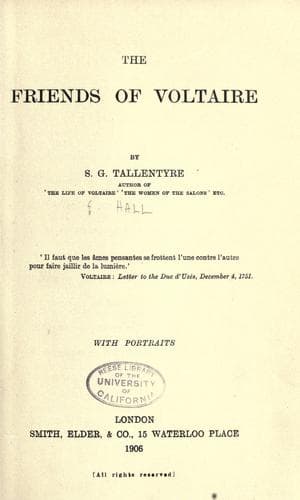
France -- Biography; Voltaire, 1694-1778 -- Friends and associates
The man who called himself ‘the apologist of strong passions,’ who
thought marriage ‘a senseless vow,’ and ‘was always very near to the
position that there is no such thing as an absolute rule of right and
wrong,’ would not be likely to be faithful. He was not faithful. There
soon loomed on the scene a Madame Puisieux (the wife of a barrister),
aged about five-and-twenty, charming, accomplished, dissolute. Diderot
plunged headlong into love with her, as he plunged headlong into
everything. To be sure, she was abominably extravagant and always
wanting money. To gratify her demands Diderot wrote, most
characteristically, an ‘Essay on Merit and Virtue,’ and brought Merit
and Virtue the sum he received in payment. But Madame’s love of fine
clothes was insatiable. Between a Good Friday and Easter Day her lover
composed for her the ‘Philosophical Thoughts,’ which first made him
famous, which were paid the compliment of burning, and for which his
mistress received fifty louis.
The history of the inspiration of masterpieces would afford a
peculiarly interesting insight into human nature. It may be set down to
the credit of Madame Puisieux (history knows of nothing else to her
credit) that her rapacity at least forced this incorrigible
ne’er-do-weel upon his destiny, and first turned Diderot, the most
delightful scamp in the capital, into Diderot the hard-working
philosopher and man of genius.
Nanette came home presently, having earned the love and admiration of
the little family at Langres, and put up with Madame Puisieux as best
she could. Other children were born to her, and died; only one, little
Angélique, survived. Of the quantity of Diderot’s love for this child
there is no doubt; it is only the quality that is questionable.
Self-indulgent to himself, he was weakly indulgent to her. She was apt
at learning, so, when they both felt inclined, he taught her music and
history. Later, when she was ill, he wrote letters about her full of
ardent affection; but he left her mother to nurse her and went off gaily
to amuse himself with his friends, and then took great credit for having
given ‘orders which marked attention and interest’ in her, before he
went out and dined with Grimm under the trees in the Tuileries.
Of course Angélique loved the lively good-natured father much the better
of the two. Of her mother the daughter herself said afterwards, with a
sad truth, that she would have had a happier life if she could have
cared less for her husband.
However, Denis was working now, and working meant, or should mean, ease
and competence.
Public-domain text, read in full here on John Shaqi.
Reviews
Reviews
No reviews yet
Be the first to share your thoughts on this work.
Join the Discussion
Join the discussion
Sign in to leave a comment or review.
Sign InorCreate an account