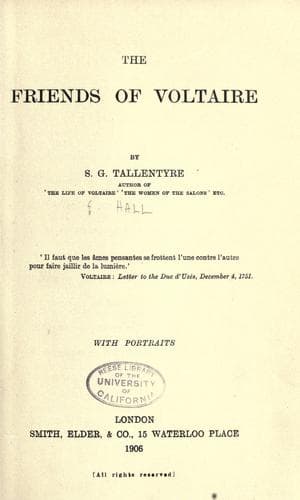
France -- Biography; Voltaire, 1694-1778 -- Friends and associates
He started up in a second, raging and cursing, and went out with his
life in his hand. Seizing his pen, he slashed, hewed, hacked, with that
reckless weapon on every side. Vincennes and the Bastille loomed
ominously; he was never sure one day, says his daughter, of being
allowed to continue the next; but he went on. The authorities might
burn, but they could not destroy; they might prohibit, but they could
not daunt a Diderot.
In 1764, despite galleys and bonfires, kings, ministers, and _lettres de
cachet_, the last ten volumes were ready to appear in a single issue and
to crown his life’s labour, when fate struck him a last crushing blow.
When the manuscript of the articles had been burnt he discovered that
the false Le Breton, fearing for his own safety, had cut out all such
passages as he thought might endanger it; and had thus mutilated and
ruined the ten volumes past recall.
Diderot burst, literally, into tears of rage. Despair and frenzy seized
him. Was this to be the end? Not while he had breath in his body! He
attacked Le Breton with an unclean fury not often matched, and in 1765
the volumes appeared, as whole as his talent and energy could make them.
It was Diderot who said that if he must choose between Racine, bad
husband, father, and friend, but sublime poet; and Racine, good husband,
father, and friend, but dull ordinary man, he would choose the first.
‘Of the wicked Racine, what remains? Nothing. Of Racine, the man of
genius? The work is eternal.’ When one considers his Herculean labours
for the Encyclopædia, one is almost tempted to judge him as he judged
Racine.
Public-domain text, read in full here on John Shaqi.
Reviews
Reviews
No reviews yet
Be the first to share your thoughts on this work.
Join the Discussion
Join the discussion
Sign in to leave a comment or review.
Sign InorCreate an account