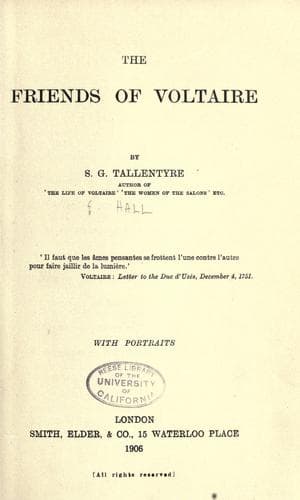
France -- Biography; Voltaire, 1694-1778 -- Friends and associates
Four years later, in 1778, he first saw in the flesh the great elder
brother of his order, the master-worker in the temple slowly lifting
its gorgeous towers towards the light--Voltaire. They had not always
agreed on paper: their goal had been the same, but not the road to it.
‘But we are not so far apart,’ says old Voltaire; ‘we only want a
conversation to understand each other.’ Accordingly, when he came on his
last triumph to the capital, Diderot went to see him in the Villettes’
house on what is now the Quai Voltaire. Few details of their interviews
have been preserved; but it is said that they discussed Shakespeare, and
that when Diderot left, Voltaire said of him: ‘He is clever, but he
lacks one very necessary talent--that of dialogue.’ On his part, Diderot
compared Voltaire to a haunted castle falling into ruins--‘but one can
easily see it is still inhabited by a magician.’
Voltaire died. Diderot was himself growing old; he had acquired, he
thought in Russia, the seeds of a lung disease. Angélique married a M.
de Vandeul, on the strength of the _dot_ provided by the sale of the
library. Madame Diderot, poor soul, had become not a little worried and
embittered. It is the careless who make the care-worn, and Diderot was
almost to the last the engaging, light-hearted scamp whose troubles are
always flung on to some patient scapegoat.
In 1783, or 1784, the death of Mademoiselle Volland gave him a real
grief. Twenty years before he had written to her with an exquisite
eloquence of the calm and gentle approach of the great rest, Death: ‘One
longs for the end of life as, after hard toil, one longs for the end of
the day.’ He proved in himself the truth of his own words. He had not
even a hope of the immortality of the soul; but he had worked hard, the
evening was come, and he was weary. He was still working--writing the
‘Life of Seneca.’ He was still his all too lovable, spontaneous self,
talking with that marvellous inspiration of which the best of his books
can convey little idea.
A fortnight before he died he moved into a new home, given him by
Catherine the Great, in the Rue Richelieu, opposite the birthplace of
Molière and almost next door to the house where Voltaire had lived with
Madame du Châtelet, and after her death. The _curé_ of Saint-Sulpice
came to see him, and suggested that a retractation of his sceptical
opinions would produce good effect. ‘I dare say it would,’ said Denis,
‘but it would be a most impudent lie.’ In his last conversation Madame
de Vandeul records that she heard him say: ‘The first step towards
philosophy is unbelief.’
The end came very suddenly. On the last day of July 1784, he was supping
with his wife and daughter, and at dessert took an apricot. Nanette
gently remonstrated. ‘Mais que diable de mal veux-tu que cela me fasse?’
he cried. They were his last words and perfectly characteristic. He died
as he sat, a few minutes later.
Public-domain text, read in full here on John Shaqi.
Reviews
Reviews
No reviews yet
Be the first to share your thoughts on this work.
Join the Discussion
Join the discussion
Sign in to leave a comment or review.
Sign InorCreate an account