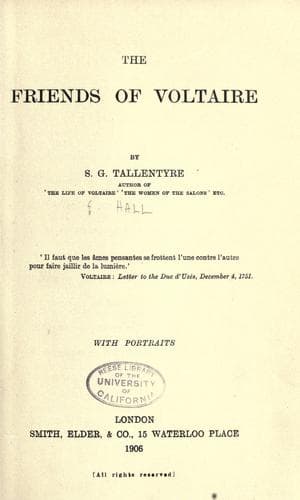
France -- Biography; Voltaire, 1694-1778 -- Friends and associates
The talk ranged from the history and customs of the Chinese to the final
annihilation of the human race. Sometimes it lit on ‘Clarissa Harlowe,’
and the company divided itself into For and Against Sentiment as
understood by the bookseller Richardson. Occasionally the meal was given
up to buffoonery, and Madame d’Aine led the way with jokes of such a
character that if Morellet is conscientious in declaring in his
‘Memoirs’ that all freedoms, except freedoms as to speculation, were
banished from d’Holbach’s gatherings, he must certainly have been deaf.
One day, a story going the round of the Paris cafés, holds the table
curious and laughing. The Baron, says Grimm, was as amusingly credulous
of gossip as he was sceptical of everything else. Another day, it is a
question of _ton_ or of _mode_; and a third, of art or of literature.
There was scarcely one of d’Holbach’s _convives_--there was not one of
Voltaire’s co-operators--who did not contribute, at one time or another,
a masterpiece, or at least a Book of the Moment, for d’Holbach’s table
to discuss.
In 1755, it is the famous article on ‘Existence’ in the Encyclopædia, by
young Turgot, our shy, rare guest, which brings the heads of the older
Encyclopædists together over the walnuts and the wine, and inspires them
with prophecies of a great future for its quiet author. Three or four
years later, the great suppression of that Encyclopædia itself inflames
the passions of the party, goads Diderot to fury, and d’Alembert to
despair.
In 1759, the ‘Candide’ of the Master sets the table in a roar of
delight. ‘The Social Contract’ of our impossible, impassioned Jean
Jacques sounds for us, in 1762, the trumpet-note of battle in that
sonorous opening sentence: ‘Man is born free, and is everywhere in
chains.’ The next year, the guests give their ever-generous admiration
to a far wiser work--one of the mightiest weapons ever forged against
‘the greatest of human curses’--‘The Treatise on Tolerance.’ In 1765,
d’Alembert comes out of his shell again with his ‘History of the
Destruction of the Jesuits;’ while Diderot is for ever finger deep in
ink--up to the neck in ideas.
Only, at the head of the table, d’Holbach, host and president, always
applauding, encouraging, (and sometimes also financing) the producers,
himself produces nothing. Yet it is not because he does not go, as it
were, with his guests. He goes far beyond them. Here, the women of the
party left the table after dinner as they do in England, to exchange
what Diderot called their ‘little confidences.’ Then the conversation
took, not the kind of freedoms which Morellet declared he did not hear,
but speculative liberties which, said he, ‘would have brought down
thunderbolts on the house a hundred times if they ever fell for that.’
Public-domain text, read in full here on John Shaqi.
Reviews
Reviews
No reviews yet
Be the first to share your thoughts on this work.
Elsewhere in the archive
Join the Discussion
Join the discussion
Sign in to leave a comment or review.
Sign InorCreate an account