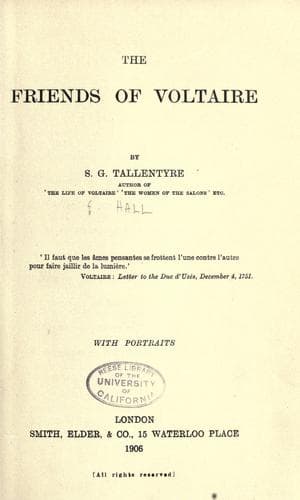
France -- Biography; Voltaire, 1694-1778 -- Friends and associates
In the forenoon, the guests were left entirely to their own devices, and
unless by special arrangement, never met each other or their host until
dinner-time at half-past one or two. Some of them had arrived with a
_chef-d’œuvre_ in their pockets--or, it might be, up their sleeves.
Here, in the pleasant solitude of these morning hours, Galiani, no
doubt, was ‘settling the question of the Corn Laws,’ Grimm engrossed
with his ‘Literary Correspondence,’ and Hoop arranging his pessimism
into a regular system. (Madame d’Aine had thoughtfully provided Hoop
with a bedroom overlooking the moat, so that he could at any moment put
his principles into practice and throw himself into it.) Diderot, beside
his open windows and with the solace of a cup of tea, wrote for
Mademoiselle Volland those descriptions of life at Grandval to which all
narrators of it are indebted.
As for the Baron--the Baron always seemed to have plenty to do in that
magnificent library, where he could invariably find chapter and verse
for the maddest of Diderot’s theories, but where the actual nature of
his occupation was known only to Diderot himself, to a certain very
useful friend called Naigeon, who, having been painter and sculptor, had
finally settled into a philosopher, and to La Grange, the d’Holbach
children’s tutor.
It is charitable to suppose that the women also performed their duties
in the morning, since it is certain they performed none at any other
time of day. But in this age, if a woman was witty and charming, her
_métier_ was considered to be fulfilled, and she not only did nothing
practical for the good of humanity, but, better still, never even felt
she ought to be doing something. Madame d’Holbach had her lute and her
embroidery frame, the kindest of clever husbands, those engaging babies,
and a perpetual house party. What more _could_ be expected of her? Of
Madame d’Aine, it is not recorded that she had any other _rôle_ than
that of adding to the gaiety of her household.
At about half-past one, then, the work of the day was done, and hosts
and guests met in the _salon_, and went in to dinner--the famous dinner,
exquisitely arranged and appointed; servants numerous, noiseless, and
perfectly _au fait_ in their duties; the most delicate wines, and the
most irreproachable of _chefs_. A couple of Englishmen, perhaps, and
half a dozen French men and women had driven down to it from Paris.
There were generally from twelve to fifteen persons at table, and
sometimes more. Good as the fare was--much too good for the health of
some of the diners--‘the only intoxication’ at this table ‘was of
ideas.’
Public-domain text, read in full here on John Shaqi.
Reviews
Reviews
No reviews yet
Be the first to share your thoughts on this work.
Elsewhere in the archive
Join the Discussion
Join the discussion
Sign in to leave a comment or review.
Sign InorCreate an account