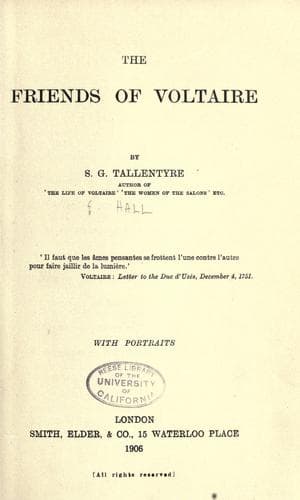
France -- Biography; Voltaire, 1694-1778 -- Friends and associates
When the walkers returned the evening was drawing in, and there were
lights and cards on the table. Some of the guests rested on long chairs.
Some played picquet, some billiards, some tric-trac. Some visited their
host’s picture gallery or his famous cabinet of natural history. He was
himself always pleasant, courteous, cheerful. He loved to rally gently
‘the old mummy,’ as he called Father Hoop, and, perhaps, other Fathers,
certain Jesuit priests, whom, in defiance of all his own principles, he
generously made free of his house.
Old Madame d’Aine entertained the whole company with her perfectly
indecorous and perfectly good-natured wit. Madame d’Holbach, always
‘douce et honnête,’ ‘très aimable,’ and exquisitely dressed (the
description is Madame d’Épinay’s), accepted her mother’s buffooneries
with absolute complacency.
Coarse as this society was in its speech--worse as it was in its easy
condonation of vice than the worst social sets of our own day--in one
respect at least it was immeasurably superior. Except for an occasional
desultory game proposed by their hosts, the guests at Grandval were
expected to bring, and did bring, their own entertainment with them in
their own heads. To be bored would have been to confess oneself stupid.
For the costly freaks of amusement, the elaborately idiotic devices of
modern times to prevent the visitor having to fall back for an instant
on his own resources or intelligence, Grandval had no need. If
materialism was its creed, there was, as has been justly said, a great
deal of ‘indirect spiritualism’ in its practice. Its lengthy dinners
_were_ feasts of reason (in spite of those intellectual extravagances)
as well as of costly meats and wines, and the ill-flavoured jests were
only interludes in the midst of brilliant and fruitful talk on
literature, history, politics, and the new world beginning for France.
Supper came about nine--‘wit, gaiety, and champagne,’ Diderot described
it. Then more conversation, until sometimes the party were still
ardently philosophising with their bedroom candle-sticks in their hands.
When d’Holbach had been entertaining, apparently without a break, for at
least ten years, he took what seemed to his friends the foolhardy, not
to say desperate, resolve of crossing the Channel. To bury himself in
what Diderot called ‘the depths of England’ for two months is a very
different thing, the Baron will find, from entertaining Englishmen (and
those quite the most enlightened of their species) in Paris! He did find
it so. If England delighted Voltaire, soothed wounded Helvétius, and
pleased even critical Grimm, she thoroughly disgusted d’Holbach. He gave
Diderot his vivid first impressions of her, and Diderot retailed them,
red-hot, for Sophie Volland and for posterity.
Public-domain text, read in full here on John Shaqi.
Reviews
Reviews
No reviews yet
Be the first to share your thoughts on this work.
Elsewhere in the archive
Join the Discussion
Join the discussion
Sign in to leave a comment or review.
Sign InorCreate an account