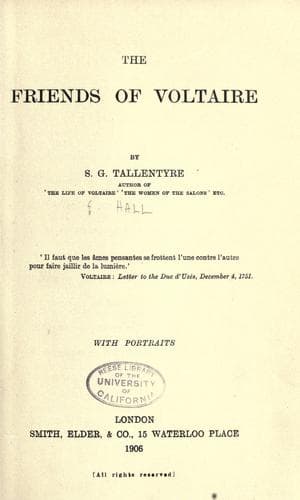
France -- Biography; Voltaire, 1694-1778 -- Friends and associates
The Baron was hospitably received and entertained in this island by a
rich and generous host, whose name has not transpired; he had the best
of health during his visit, and he paid that visit in August, when even
the British climate can be very tolerable; he had the pleasure of
calling on his guest, Garrick; he went to Oxford and Cambridge;
travelled in some of the prettiest English counties, and he was
bored--to extinction.
Our confessedly bad manners he found worse than anyone had ever found
them before, and was dreadfully disgusted with people ‘on whose faces
one never sees friendliness, confidence, or gaiety, but which all wear
the inscription, “What is there in common between you and me?”’ The
aristocracy struck him as cold and haughty, the common people as rough
and violent. As for the dinner parties, ‘where people sit according to
their rank, and formality and ceremony are beside each guest,’ after the
gracious ease of Grandval, the Baron may be forgiven for finding them
intolerable.
Then the public entertainments: ‘This people is sad and melancholy,
especially in places built for pleasure. You can hear a pin drop. A
hundred stiff and silent women promenade round an orchestra discoursing
the most delicious music,’ and the promenade can only be compared to
‘the processions of the Egyptians round the mausoleum of Osiris.’
Then the gambling: ‘Englishmen lose incredible sums in perfect silence.
By thirty they have exhausted all the pleasures, even beneficence. Ennui
... conducts them to the Thames, unless they prefer a pistol.’
At the universities, the good Baron found many ‘rich do-nothings
drinking and sleeping half the day;’ at Court, corruption; among the
people, no public education and great inequality of riches. The King, to
be sure, was powerful chiefly to do good, but still he was much the
master. With regard to religion, ‘the Christian religion,’ said the
Baron, ‘is almost extinct in England.’ This was an advantage from his
point of view. But then, though there were innumerable Deists, like
Hume, there was not an atheist, or not an avowed one. The travelling
facilities he praised--there were always post-horses in plenty; and at
the meals at inns, he found himself ‘served promptly, but with no
affability.’ It must be owned that now and again the Baron has us on the
hip.
But, after all, there was very great good in England: it made one so
delighted to get back to France. D’Holbach, who had left Paris about
August 1, 1765, had returned there by September 20. He dined that same
evening with his dear Diderot and a whole colony of English, ‘who had
left their _morgue_ and sadness on the banks of the Thames.’
Two years after his return, there appeared, not only to the horror of
Court, Church, and Government, but to the horror of the philosophers
also, a book called ‘Christianity Unveiled, or an Examination of the
Principles and Effects of Revealed Religion.’
Public-domain text, read in full here on John Shaqi.
Reviews
Reviews
No reviews yet
Be the first to share your thoughts on this work.
Elsewhere in the archive
Join the Discussion
Join the discussion
Sign in to leave a comment or review.
Sign InorCreate an account