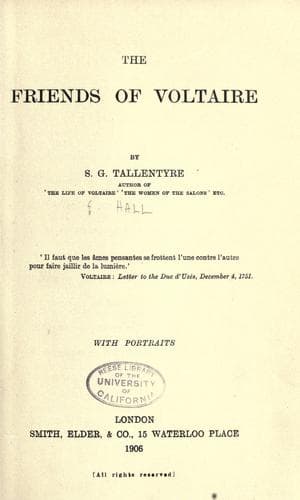
France -- Biography; Voltaire, 1694-1778 -- Friends and associates
Of no settled length and in manuscript, it was despatched to its
subscribers twice a month. It had no fixed price, its readers paying as
much as they chose for it, or as much as Grimm could make them pay. His
old friend the Duchess of Saxe-Gotha was, as has been seen, one of his
first subscribers. The Landgrave of Hesse, the Queen of Sweden, and
Catherine the Great of Russia soon joined his select and limited
_clientèle_. Stanislas Augustus, King of Poland, the Margrave of
Anspach, and the Grand Duke of Tuscany joined later. Frederick the
Great, after his unlucky experience with Theriot, was extremely dilatory
and vacillating in having anything to do with it; when he did add his
name to the list of subscribers he never paid his subscription and
harried Grimm to insert the scandals and the _on dits_ of the _cafés_
and the Court, which Grimm declined to do.
For greater security, the sheets did not go through the post, but
through the legations of the various countries. The thing was, in fact,
a secret, and a well-kept secret, for more than half a century, and
never knew the danger of print until it was published in 1812, under the
Empire, with many cautious Napoleonic omissions. In the meantime, its
secrecy and the limited number of its readers gave the discreet Grimm,
who declared that the most enlightened reasoning was not worth a night
in the Bastille, and who was cautious to the very fibre of his bones,
the opportunity of being at once candid, impartial, and safe.
He set forth a flaming prospectus, promising an ‘unlimited
truthfulness.’ The sheets shall be ‘dedicated to confidence and
frankness!’ They were. To those distant Courts and Kings there went
forth every fortnight the inimitable criticisms of the most bold, just,
and cool critic who ever breathed. He not only analysed, with
extraordinary brilliancy and fairness, the writings of Voltaire, of
friend Rousseau, and of Buffon, but he sat in discerning judgment on the
works of English novelists and poets. He criticised books which have not
lived, in criticisms which are undying. As to the value and the
longevity of the productions, he was sometimes, naturally and
inevitably, mistaken; but as a rule his opinions have been confirmed by
posterity and have weathered the test of time.
He also described to his readers the condition of the drama, the plots
of the plays, the art of the players. Of course he was clever enough if
the season was rather a dull one, to fill out his pages with extracts
from a tragedy or from a novel; sometimes, it is said, the ingenious man
gave quotations from works which had never been written.
Public-domain text, read in full here on John Shaqi.
Reviews
Reviews
No reviews yet
Be the first to share your thoughts on this work.
Elsewhere in the archive
Join the Discussion
Join the discussion
Sign in to leave a comment or review.
Sign InorCreate an account