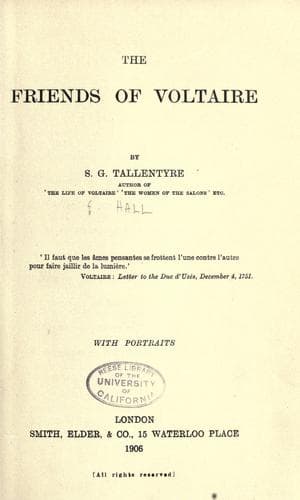
France -- Biography; Voltaire, 1694-1778 -- Friends and associates
It is always a vexed point of morals to determine how far right can come
out of wrong, how far a cause initially bad can be said to be good in
its results. It must certainly be conceded in Grimm’s case that, having
put himself into a false position and remaining there, he acted not only
sensibly and discreetly, but even honestly and conscientiously. He
found Madame d’Épinay silly, as are so many clever women, and he
insisted on her behaving with judgment and discretion. One of his first
acts was to demand that her old lover, Francueil, whom she still
permitted to visit her as a friend, should be given his dismissal. With
Duclos, man of letters, and of character rough, dissipated, and
unscrupulous, he bade her break entirely. Then he turned to Rousseau.
It has been justly said of Grimm that he never lost a friend save Jean
Jacques. In 1756 Madame d’Épinay, acting on one of those excessively
foolish impulses which she herself felt to be wholly fascinating, and
which had already more than once shipwrecked her life, gave Rousseau the
little Hermitage in the forest of Montmorency, close to her own
country-house of La Chevrette.
Grimm had not known Rousseau for six years without knowing his heart. He
looked up suddenly from the ‘Correspondence.’ ‘You have done Rousseau a
bad service,’ he told Madame d’Épinay sternly, ‘and yourself a worse.’
Still, it was done. In 1757, that _belle laide_, Madame d’Houdetot, also
had a house close to La Chevrette, and there attracted the notice of
Rousseau. After a brief summer day of delight, she grew tired of her
vehement admirer, or her lover, Saint-Lambert, grew tired of him for
her. At any rate, there burst over those three houses in the Montmorency
forest a storm of fierce passions and scandalous recriminations. All
Paris stood watching. Diderot plunged impulsively into that angry sea.
Rousseau accused Madame d’Épinay, in terms which no self-respecting
woman could have forgiven, of being the writer of a certain fatal
anonymous letter; and she forgave him. Grimm had been appointed
secretary to the Duke of Orleans, and was absent on duty in Westphalia.
He did not spare his little mistress’s pusillanimous weakness. ‘Your
excuses are feeble ... you have committed a very great fault,’ he wrote.
Hurrying home, he dealt with Rousseau in terms of unmistakable
plainness. He made Madame d’Épinay cast him off there, at once, and for
ever, and carried her off to Geneva on the excuse, a just excuse in
every sense, of her health.
Public-domain text, read in full here on John Shaqi.
Reviews
Reviews
No reviews yet
Be the first to share your thoughts on this work.
Elsewhere in the archive
Join the Discussion
Join the discussion
Sign in to leave a comment or review.
Sign InorCreate an account