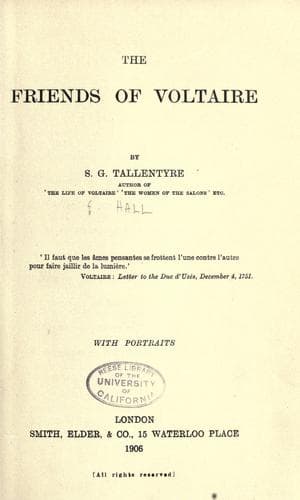
France -- Biography; Voltaire, 1694-1778 -- Friends and associates
He was himself not only the first critic of his day, but he was thinker
as well as chronicler, worldling and scholar, reporter and _savant_.
Foreigner though he was, he had learnt to write the French language in a
style inimitably clear, supple, and forcible. His command of irony alone
should have been a fortune to him. Add to this, his singularly wise,
calm head, and his unrivalled position as the friend of the women of the
_salons_ and the nobility of Paris as well as of its writers and
politicians. Further, this critic of music was himself a musician, this
judge of authors himself an author. He lived in one of the most
momentous and thrilling periods in the history of this earth, and in one
of the most stimulating of her cities, and was able to write wholly
without fear of consequence for readers of whose intelligent interest he
was sure, while he had ever before him the magnificent hope of so
opening the hearts and feeding the knowledge of those readers that they
might turn and do good unto their people and be a blessing, and not a
curse, to their lands.
Consider all this, and it is not marvellous that Grimm remains the first
journalist and the ‘Literary Correspondence’ the first newspaper in the
world.
It is hardly necessary to say that it gave its editor an enormous amount
of work. _Chaise de paille_, his friends called him in allusion to his
diligence; later, when he began to travel, Grimm suggested the nickname
should be altered to _chaise de poste_. He had many secretaries working
under him. One, Meister, was attached to him all his life, and benefited
largely under his will. When he was away from Paris the good-natured
Diderot made a brilliant substitute; and Madame d’Épinay took up a
delicate pen to become the first, and surely the most charming, of women
journalists.
Only a few months after his arrival in Paris Grimm had been introduced
to this little black-eyed, bright-witted, and all too seductive wife of
a worthless husband. In 1752, at Frisen’s table, he had heard her name
insulted, and had fought a duel for its honour. By 1755, on his return
from his journey with d’Holbach, he became a familiar figure in her
_salon_. First her wise and masterful friend, he was soon her despotic
lover.
Public-domain text, read in full here on John Shaqi.
Reviews
Reviews
No reviews yet
Be the first to share your thoughts on this work.
Elsewhere in the archive
Join the Discussion
Join the discussion
Sign in to leave a comment or review.
Sign InorCreate an account