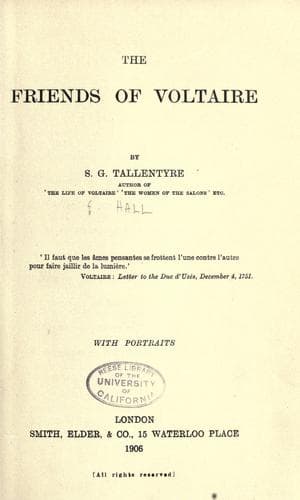
France -- Biography; Voltaire, 1694-1778 -- Friends and associates
He met Frederick the Great when he was travelling in Germany in 1769;
and Frederick, forgetting his grievance that Grimm would not turn the
‘Correspondence’ into a scandalous society newspaper, fell under the
spell of his fellow-countryman’s encyclopædical knowledge and dignified
affability. Grimm, said Meister, had the rare talent of living with
great people without losing any of the freedom and independence of his
character.
When he was nearly fifty years old, in 1771, he resumed an employment of
his youth, and, at a very large salary, consented to be tutor to the
Hereditary Prince of Hesse, a boy about nineteen. The pair went to
England and were well received at its ultra-German Court. Grimm was
delighted with ‘the simplicity, the naturalness, and the good sense’ of
the English character. The Landgravine, young Hesse’s mother, sold her
diamonds that her son might prolong his visit in so delightful a
country. And then Grimm brought him back to Paris and formed his mind
and manners in the society of d’Holbach and Diderot, of Madame Necker
and Madame Geoffrin.
In 1773, tutor and pupil went to St. Petersburg to attend the marriage
of Wilhelmina, the Prince of Hesse’s sister, with the Czarevitch Paul.
In a very short time the skilful Grimm had gained the great Catherine’s
interest and consideration. Even Diderot’s warm heart and glowing genius
(he was staying at the Russian Court when Grimm arrived there) did not
win her so well as the German’s delicate tact and keen perceptions.
Herself before all things a great statesman, how should she not respect
the shrewd judgment, the strength, and the determination of a Grimm? It
is so rare to be clever and wise! It was most rare in the eighteenth
century. Two or three times a week Grimm dined with her Majesty _en
petit comité_--those dinners at which all men were equal, and at which
no servants appeared to hamper the conversation. Afterwards she talked
alone with him by the hour together. He told Madame Geoffrin how, when
he left her, he would pace his room all night with the splendid ideas
she had suggested coursing through his sleepless brain: ‘The winter of
1773-74 passed for me,’ he said, ‘_en ivresse continuelle_.’ But when
Catherine would have permanently attached him to her service, his stern
good sense helped him to refuse. There is no such dead-weight on genius
as a post at Court--be it the Court of a Catherine or a Frederick--and
Grimm knew it. ‘I have never seen you hesitate about anything,’ Madame
d’Épinay had once written to him; ‘when you have once decided with your
just, strong mind, it is for ever.’
Public-domain text, read in full here on John Shaqi.
Reviews
Reviews
No reviews yet
Be the first to share your thoughts on this work.
Elsewhere in the archive
Join the Discussion
Join the discussion
Sign in to leave a comment or review.
Sign InorCreate an account