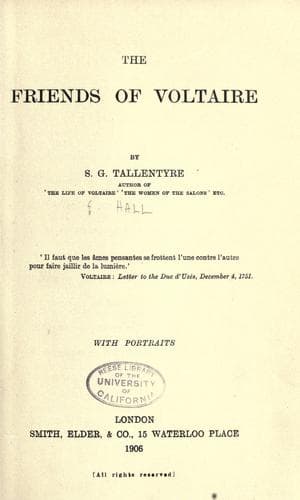
France -- Biography; Voltaire, 1694-1778 -- Friends and associates
He was living now in the Rue de la Chaussée d’Antin. His love of music
was still strong, and on young Mozart’s visits to Paris, Grimm was his
kindest and most influential patron. The next few years saw the deaths
of many old friends--of Voltaire, of Diderot, of Frederick the Great,
of d’Holbach, and of Madame d’Épinay. For ever trying to conciliate all
men, poor little volatile, self-deceived deceiver, under Grimm’s
masterful influence the best qualities of her nature had come to the
fore and the worst receded. She was to the last true to him as she had
never been true to anyone else. Grimm adopted her grand-daughter and
married her to the Comte de Bueil.
So far, his own life had been singularly happy and successful. If he had
loved unwisely, he had taken care that the affection should never be of
that inordinate kind which is its own punishment. He had, too, one of
the dearest solaces of declining life in seeing young people growing up
about him. As to his career, he was not only attached to the royal house
of Orleans, but he was by now Catherine’s Councillor of State, Minister
Plenipotentiary to the Duke of Saxe-Gotha, and Baron of the Viennese
Empire. He was a rich man, with a fine collection of books, pictures,
and _vertu_. He should have died before 1789.
In that year came the stunning fall of the Bastille. Of liberty, Grimm
had talked easily enough, but he had also been shrewd enough to doubt
its promises. He had at least nothing of the calm confidence of the fine
ladies of the old _régime_ who drove out from modish Paris through the
Faubourg Saint-Antoine to look at the ruins of the great prison, as at a
sight prepared--for their amusement. To the wary German the destruction
of the Bastille spelt the ruin of France. The Revolution sped
on--Vengeance rushing through the night with a drawn sword in her hand.
In 1790 came the great emigration of the nobles. Who should be suspect
if not this correspondent of kings? Grimm fled to Frankfort; but in two
months’ time he plunged again into the whirlpool of Paris, to rescue the
Comtesse de Bueil, his dear adopted grandchild, then in sore straits. He
took her to Aix-la-Chapelle; but in October 1791 he returned himself to
the capital, to get the Empress’s letters out of France if he could. He
found he had already been denounced in the committees as carrying on a
correspondence with her ‘little favourable to the Revolution.’ His only
chance of safety lay, he saw, in ‘extreme circumspection.’ He had that
quality by nature to the full; but, none the less, stirred by a generous
pity, history tells of an interview he had with the royal saint, Madame
Elisabeth, in which he tried to assist both her and Marie Antoinette. He
could do nothing; fate and the fatal Bourbon character were too strong
for the Bourbons to be saved.
Public-domain text, read in full here on John Shaqi.
Reviews
Reviews
No reviews yet
Be the first to share your thoughts on this work.
Elsewhere in the archive
Join the Discussion
Join the discussion
Sign in to leave a comment or review.
Sign InorCreate an account