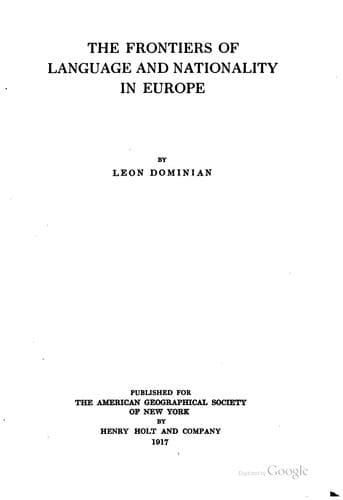
The Frontiers of Language and Nationality in EuropeDominian, Leon
History
The Frontiers of Language and Nationality in Europe
Dominian, Leon
Europe -- Languages; Nationalism
The Saxon colony adjoining the Szekler area on the west is also a
relic of medieval strategic necessities. In spite of the name by
which this German settlement is designated, its original members
appear to have been recruited from different sections of western
European regions occupied by Teutons.[158] Colonization had
already been started when King Gesa II of Hungary gave it a fresh
impulse, in the middle of the twelfth century, by inducing peasants
of the middle Rhine and Moselle valleys to exchange servitude
in their native villages for land ownership in the Transylvania
area.[159]
To promote the efficiency of these colonists as frontier guardsmen
an unusual degree of political latitude was accorded them. In time
their deputies sat in the Hungarian diet on terms of equality with
representatives of the nobility. Prolonged warfare with the Tatar
populations who attempted to force entrance into the Hungarian
plains, led to the selection of strategical sites as nuclei of
original settlements. These facts account for the survival of the
Teutonic groups in the midst of Rumanians and Hungarians. Today
the so-called Saxon area does not constitute a single group, but
consists of separate agglomerations clustered in the vicinity
of the passes and defiles which the ancestors of the Teutons
were called upon to defend. The upper valley of the Oltu and its
mountain affluents, in the rectangle inclosed between the towns of
Hermannstadt, Fogaras, Mediasch and Schässburg, contain at present
the bulk of this Austrian colony of German ancestry.
[Illustration:
FIG. 42--View of the Transylvanian plateau near the western edge
of the Carpathians. Hosszufalu (Langendorf) in the distance.]
The Rumanian problem in Hungary is mainly economic. The chief aim
of Hungarians is to maintain political supremacy in the provinces
containing a majority of the Romance-speaking element. The Rumanian
communities are scattered over an area of about 76,000 square
miles (122,278 sq. kms.) which comprises Transylvania and its old
“exterior” counties as well as the Banat. This region is peopled
by 6,305,666 inhabitants according to recent census figures. Of
these 87.8 per cent consist of peasants. The number of Rumanians is
officially estimated at 2,932,214. Rumanian students, however,
point to official Austrian returns for the year 1840 which placed
the number of their countrymen at 2,202,000[160] and lay stress
on the coefficient of increase for the period 1870 to 1910, which
is 15.5 per thousand in Rumania and 10.8 per thousand in Hungary.
Applying the Rumanian rate to the Rumanian subjects of the
Hapsburgs they find that their kinsmen in Hungary ought to number
approximately 3,536,000. Otherwise it is necessary to admit that
between 1840 and 1890 Magyars increased 54 per cent, and Rumanians
only 17 per cent, in spite of the recognized fact that Rumanian
peasants have larger families than their Hungarian masters.[161]
Public-domain text, read in full here on John Shaqi.
Reviews
Reviews
No reviews yet
Be the first to share your thoughts on this work.
Elsewhere in the archive
Join the Discussion
Join the discussion
Sign in to leave a comment or review.
Sign InorCreate an account