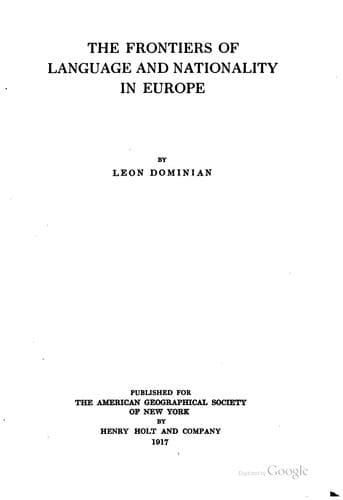
The Frontiers of Language and Nationality in EuropeDominian, Leon
History
The Frontiers of Language and Nationality in Europe
Dominian, Leon
Europe -- Languages; Nationalism
The picture of this linguistic evolution can be painted only with
the colors of geography. The well-defined individuality of the
Hungarian Puszta has its counterpart in the Siberian steppe region.
The one is the reproduction of the other in small--a miniature.
Both consist of undulating land, devoid of mountains or hills, and
covered by deep sand. In Finland too a remarkably level stretch
of granite land, marked by gentle swelling, lies under a sandy
glacial mantle. The two European regions have only one advantage
over their Asiatic type. They are better watered. The furthest
penetration of Eurasian lowlands into Europe is obtained through
them. The approach to Hungary is made without a break, through
the valley of the Danube. To Finland access is equally easy once
the Urals are crossed. That this range proved no obstacle to the
westerly spread of central Asiatic peoples is indicated by their
presence west of its axis and their settlement in the Volga valley
prior to Slav inroads. But neither in lake-dotted Finnish lands
nor within the limited and mountain-hedged area of Hungary could
the Asiatic invaders find room for expansion or nomadism. From
herdsmen they became farmers. The change is the dawn of their
history as a European nation, and of the development of every
manifestation of their culture. A more advanced language became the
measure of the increasingly complex character of their needs--that
is to say, of higher civilization. The whole story, traced from
its origin, illustrates the superior civilizing power vested in
European geography. In the sterile steppes of the northern half
of Asia man led an easier life than in the cramped regions of
diversified Europe. On the broad flatlands of the east he roamed
with little thought of the morrow and without incentive to improve
his condition. In the west he was spurred to activity by the very
limitations of his homeland.
In our day about seventy different languages are spoken in Russia.
In this fact is found a serious drawback to effective national
unity. Fortunately the spread of the dialects belonging to the
Slavic group of languages is steady. The thorough Slavicization of
the peoples of the basin of the Volga is not yet ended, but Great
Russian is gradually uprooting the native Uralo-Altaic tongues.
It is also imposing itself upon Asiatic languages in Caucasia and
Transcaspian territory. Wherever there has been a thorough blending
of dialects into Russian, nationality has sprung into existence.
Elsewhere unity is in process of formation. The problem before
the governing class consists in hastening the assimilation of the
different elements to the original Slavic nucleus. Not until this
consummation has taken place will the country have developed its
full strength. And the measure of progress will be indicated by the
growing replacement of the numerous dialects by a single national
language.
Public-domain text, read in full here on John Shaqi.
Reviews
Reviews
No reviews yet
Be the first to share your thoughts on this work.
Join the Discussion
Join the discussion
Sign in to leave a comment or review.
Sign InorCreate an account