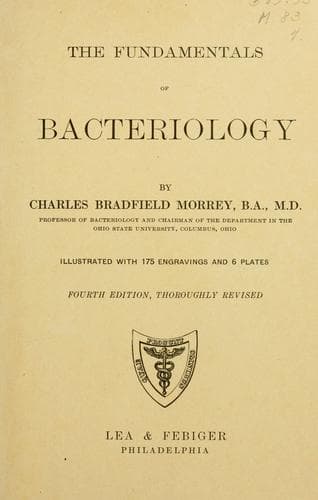
The Fundamentals of BacteriologyMorrey, Charles Bradfield
Science
The Fundamentals of Bacteriology
Morrey, Charles Bradfield
Bacteriology
The discoveries of Leeuwenhoek which proved the existence of
microscopic organisms soon revived the “contagium vivum” idea of
Kircher. Nicolas Andry in a work published in 1701 upheld this view.
Lancisi in 1718 advanced the idea that “animalcules” were responsible
for malaria, a view not proved until Laveran discovered the malarial
parasite in 1880.[1] Physicians ascribed the plague which visited
Southern France in 1721 to the same cause, and many even went so far as
to attribute all disease to animalcules, which brought the theory into
ridicule. Nevertheless the “contagium vivum” theory survived, and even
Linnaeus in his _Systema Naturæ_ (1753-6) recognized it by placing the
organisms of Leeuwenhoek, the contagia of diseases and the causes of
putrefaction and fermentation in one class called “Chaos.”
Plenciz, a prominent physician and professor in the Vienna Medical
School, published in 1762 a work in which he gave strong arguments for
the “living cause” theory for transmissable diseases. He taught that
the agent is evidently transmitted through the air and that there is
a certain period of incubation pointing to a multiplication within
the body. He also believed that there was a specific agent for each
disease. His writings attracted little attention at the time and the
“contagium vivum” theory seems to have been almost lost sight of for
more than fifty years. Indeed, Oznam, in 1820, said it was no use to
waste time in refuting hypotheses as to the animal nature of contagium.
Isolated observers, were, however, keeping the idea alive, each in
his own locality. In 1787 Wollstein, of Vienna, showed that the pus
from horses with glanders could infect other horses if inoculated
into the skin. Abilgaard, of Copenhagen, made similar experiments at
about the same time. In 1797 Eric Viborg, a pupil of Abilgaard’s,
published experiments in which he showed the infectious nature not
only of the pus but also of the nasal discharges, saliva, urine, etc.,
of glandered horses. Jenner in 1795-98 introduced vaccination as a
method of preventing smallpox. This epoch-making discovery attracted
world wide attention and led to the overcoming of this scourge which
had devastated Europe for centuries, but contributed little or nothing
to the question of the causation of disease. Prevost’s discovery of
the cause of grain rust (_Puccinia graminis_) in 1807 was the _first
instance of an infectious disease of plants_ shown to be _due to a
microscopic plant organism_, though not a bacterium in this case.
Doubtless one reason why the work on glanders and grain rust attracted
little attention among the practitioners of human medicine was owing to
the prevalent belief in man’s complete separation from all lower forms
of life. The evolutionists had not yet paved the way for experimental
medicine.
Public-domain text, read in full here on John Shaqi.
Reviews
Reviews
No reviews yet
Be the first to share your thoughts on this work.
Join the Discussion
Join the discussion
Sign in to leave a comment or review.
Sign InorCreate an account