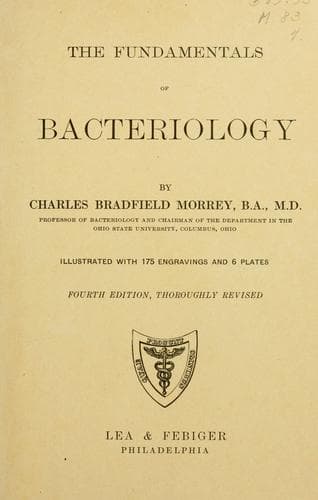
The Fundamentals of BacteriologyMorrey, Charles Bradfield
Science
The Fundamentals of Bacteriology
Morrey, Charles Bradfield
Bacteriology
2. Since chemical action always implies at least two bodies to react,
Ehrlich assumes that in every cell which is affected by a chemical
stimulus there must therefore be a chemical group to unite with this
stimulus. He further states that there must be as many different
kinds of these groups as there are different kinds of chemicals which
stimulate the cell. Since these groups are present in the body cells to
_take up_ different kinds of chemical substances, Ehrlich calls them
_receptors_. Since these groups must be small as compared with the cell
as a whole, and must be more or less on the surface and unite readily
with chemical substances he further speaks of them as “side-chains”
after the analogy of compounds of the aromatic series especially. The
term _receptors_ is now generally used. As was stated above, the effect
of _specific chemical stimuli_ is to cause the production of _more of
the particular substance_ for which it is specific and in the class
of bodies under discussion, the _particular product is these cell
receptors_ with which the chemical may unite.
3. Weigert first called attention to the practically constant
phenomenon that cells ordinarily respond by doing more of a particular
response than is actually called for by the stimulus, that there is
always an “overproduction” of activity. In the case of chemical stimuli
this means an _increased production of the specific substance_ over and
above the amount actually needed.
The student will better understand this theory if he recalls his
fundamental physiology. Living substance is characterized, among other
things, by irritability which is instability. It is in a constant,
state of unstable equilibrium. Whenever the equilibrium becomes
permanently stable the substance is dead. It is also continually
attempting to restore disturbances in its equilibrium. Whenever a
chemical substance unites with a chemical substance in the cell, a
receptor, the latter is, so far as the cell is concerned, _thrown out
of function_ for that cell. The chemical equilibrium of the latter
is upset. It attempts to restore this and does so by making a _new_
receptor to take the place of the one thrown out of function. If this
process is continued, _i.e._, if the new receptor is similarly “used
up” and others similarly formed are also, then the cell will prepare
a supply of these and even an excess, according to Weigert’s theory.
Whenever a cell accumulates an excess of products the normal result
is that it excretes them from its own substance into the surrounding
lymph, whence they reach the blood stream to be either carried to
the true excretory organs, utilized by other cells or remain for a
longer or shorter time in the blood. Hence the excess of receptors
is _excreted from the cell that forms them_ and they become _free_
in the blood. These free receptors are termed _antibodies_. _They
are receptors_ but instead of being retained in the cell are _free
in solution in the blood_.
Public-domain text, read in full here on John Shaqi.
Reviews
Reviews
No reviews yet
Be the first to share your thoughts on this work.
Elsewhere in the archive
Join the Discussion
Join the discussion
Sign in to leave a comment or review.
Sign InorCreate an account