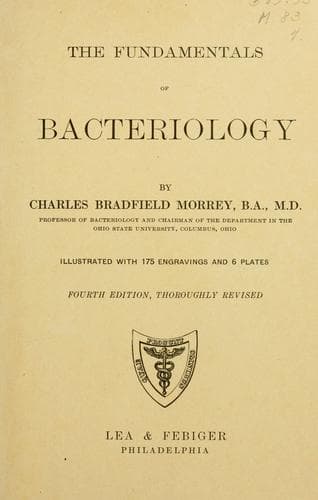
The Fundamentals of BacteriologyMorrey, Charles Bradfield
Science
The Fundamentals of Bacteriology
Morrey, Charles Bradfield
Bacteriology
One function of the free receptor, the
antibody, is _always to unite with the chemical substance which caused
it to be formed_. _It may have additional functions._ The chemical
substance which caused the excess formation of receptors, antibodies,
is termed an _antigen_ for that particular kind of antibody.
To recapitulate, Ehrlich’s theory postulates _specific chemical
stimuli_, which react with _specific chemical substances in the body
cells, named receptors_, and that these _receptors_, according to
Weigert, are _produced in excess_ and hence are excreted from the
cell and become _free receptors_ in the blood and lymph. These _free
receptors_ are the various kinds of _antibodies_, the kind depending
on the nature of the stimulus, antigen, the substance introduced. Any
substance which when introduced into the body causes the formation of
an antibody of any kind whatsoever is called an _antigen_,[23] _i.e._,
anti (body) former.
The foregoing discussion explains Ehrlich’s theory of immunity.
According to this theory the _manner of formation of all antibodies_ is
the same. The _kind of antibody_ and the _manner of its action_ will
differ with the _different kinds of antigens_ used.
The succeeding chapters discuss some of the kinds of antibodies, the
theory of their action and some practical applications. It must be
borne in mind throughout the study of these, as has been stated, that
_every antibody has the property of uniting with its antigen whether it
has any property in addition or not_.
Just what antibodies are chemically has not been determined because
no one has as yet succeeded in isolating them chemically pure. To the
author they appear to be enzymes.
Antigens were considered by Ehrlich to be proteins or to be related to
proteins. Most workers since Ehrlich have held similar views. Dr. Carl
Warden of the University of Michigan has been doing much work in recent
years in which he is attempting to show that the antigens are not
proteins but are fats or fatty acids. Mr. E. E. H. Boyer, in his work
(not yet published) in the author’s laboratory for the degree of Ph.D.,
received in June, 1920, succeeded in producing various antibodies from
_Bacterium coli_ antigens. In these antigens he could detect only fatty
acids or salts of fatty acids. If the work of these men is confirmed,
it will open up a most interesting and extremely important field in
immunity and in preventive medicine. It is not apparent that the nature
of the antigen would affect Ehrlich’s theory of the formation of
antibodies.
The author has no doubt that eventually the formation of antibodies and
the reactions between them and their antigens will be explained on the
basis of physical-chemical laws, but this probably awaits the discovery
of their nature.
CHAPTER XXVII.
RECEPTORS OF THE FIRST ORDER.
ANTITOXINS--ANTIENZYMES.
Public-domain text, read in full here on John Shaqi.
Reviews
Reviews
No reviews yet
Be the first to share your thoughts on this work.
Elsewhere in the archive
Join the Discussion
Join the discussion
Sign in to leave a comment or review.
Sign InorCreate an account