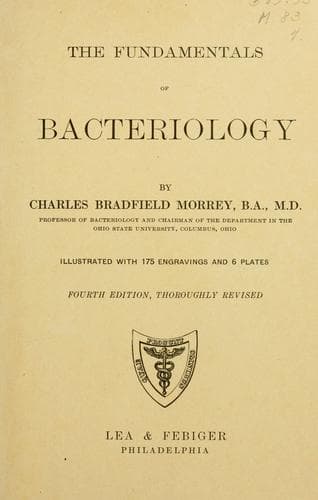
The Fundamentals of BacteriologyMorrey, Charles Bradfield
Science
The Fundamentals of Bacteriology
Morrey, Charles Bradfield
Bacteriology
In medical practice the reaction is used as a means of diagnosis in
certain diseases, such as the tuberculin test in tuberculosis, the
mallein test in glanders. The individual or animal with tuberculosis
becomes sensitized to certain proteins of the tubercle bacillus and
when these proteins in the form of tuberculin are introduced into the
body a reaction results, local or general, according to the method of
introduction. The practical facts in connection with the tuberculin
test are also in harmony with the author’s theory of anaphylaxis
as above outlined. Milder cases of tuberculosis give more vigorous
reactions because the intracellular enzymes are not used up rapidly
enough since the products of the bacillus are secreted slowly in such
cases. Hence excess of enzyme is free in the blood and the injection of
the tuberculin meets it there and a vigorous reaction results. In old,
far-advanced cases, no reaction occurs, because the enzymes are all
used in decomposing the large amount of tuberculous protein constantly
present in the blood. The fact that an animal which has once reacted
fails to do so until several months afterward likewise depends on the
fact that the _excess_ enzyme is used in the reaction and time must
elapse for a further excess to accumulate.
The anaphylactic reaction has been made use of in the identification of
various types of proteins and is of very great value since the reaction
is so delicate, particularly when guinea-pigs are used as test animals.
Wells has detected the 0.000,001 g. of protein by this test. It is
evident that the test is applicable in medico-legal cases and in food
examination and has been so used.
A TABULATION OF ANTIGENS AND ANTIBODIES AS AT PRESENT RECOGNIZED.
CLASS OF
ANTIGEN ANTIBODY ACTION OF ANTIBODY RECEPTOR
Toxin Antitoxin Combines with toxin and I.
hence prevents toxin
from uniting with a
cell and injuring it,
_i.e._, neutralizes toxin.
Enzyme Antienzyme Combines with enzyme I.
and thus prevents enzyme
from uniting
with anything else and
showing its action, _i.e._,
neutralizes enzyme.
Solution of Precipitin Unites with its antigen II.
protein and causes its precipitation
from solution.
Solution of ? Causes phenomenon of (?)
protein anaphylaxis(?)
Public-domain text, read in full here on John Shaqi.
Reviews
Reviews
No reviews yet
Be the first to share your thoughts on this work.
Elsewhere in the archive
Join the Discussion
Join the discussion
Sign in to leave a comment or review.
Sign InorCreate an account