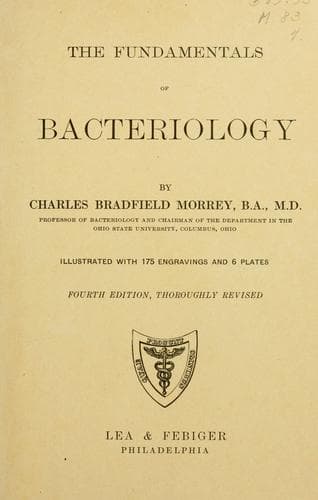
The Fundamentals of BacteriologyMorrey, Charles Bradfield
Science
The Fundamentals of Bacteriology
Morrey, Charles Bradfield
Bacteriology
Suspension of Agglutinin Unites with its antigen II.
cells causes its clumping together
and settling out
of suspension.
Suspension of Opsonin Unites with its antigen II.
cells and makes the cells (?)
more easily taken up
by phagocytes.
Suspension of Amboceptor Unites with its antigen III.
cells and also with complement
which latter then
dissolves the antigen.
Precipitin Antiprecipitin Neutralizes precipitin. I.
Agglutinin Antiagglutinin Neutralizes agglutinin. I.
Opsonin Antiopsonin Neutralizes opsonin. I.
Amboceptor Antiamboceptor Neutralizes amboceptor. I.
(two kinds)
Complement Anticomplement Neutralizes complement. I.
SUMMARY OF IMMUNITY AS APPLIED TO PROTECTION FROM DISEASE.
The discussion of “immunity problems” in the preceding chapters serves
to show that protection from disease either as a condition natural to
the animal or as an acquired state is dependent on certain properties
of its body cells or fluids, or both. The actual factors so far as at
present known may be summarized as follows:
1. _Antitoxins_ which neutralize true toxins; shown to exist for very
few diseases.
2. _Cytolytic substances_ which destroy the invading organism: in
reality two substances; amboceptor, which is specific, and complement,
the real dissolving enzyme.
3. _Phagocytosis_ or the destruction of the invading organisms within
the leukocytes.
4. _Opsonins_ which render the bacteria more readily taken up by the
phagocytes.
5. _Enzymes_ other than complement possibly play a part in the
destruction of some pathogenic organisms or their products. This
remains to be more definitely established.
6. It is possible that in natural immunity there might be no receptors
in the body cells to take up the organisms or their products, or the
receptors might be present in certain cells but of a very low chemical
affinity, so that combination does not occur. It is even highly
probable that many substances formed by invading organisms which might
injure specialized cells, such as those of glandular, nervous or muscle
tissue, have a more rapid rate of reaction with, or a stronger affinity
for, lower unspecialized cells, such as connective and lymphoid tissue,
and unite with these so that their effects are not noticed.
The importance of these different, factors varies in different diseases
and need not be considered in this connection.
Public-domain text, read in full here on John Shaqi.
Reviews
Reviews
No reviews yet
Be the first to share your thoughts on this work.
Elsewhere in the archive
Join the Discussion
Join the discussion
Sign in to leave a comment or review.
Sign InorCreate an account