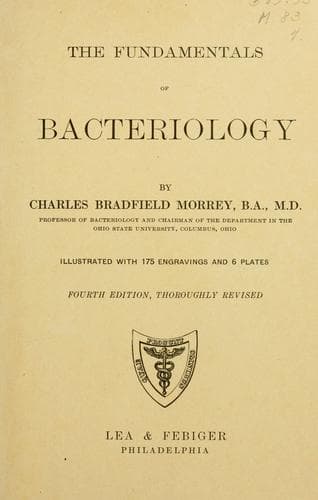
The Fundamentals of BacteriologyMorrey, Charles Bradfield
Science
The Fundamentals of Bacteriology
Morrey, Charles Bradfield
Bacteriology
on the surface of the body (pus cocci) need a less amount of water,
while those invading the tissues (tuberculosis, black-leg, etc.) seem
to be intermediate in this respect. In artificial culture media a water
content of less than 30 per cent. inhibits the growth of most bacteria.
As a general rule those bacteria which require the largest percentage
of water are most susceptible to its loss and are most readily killed
by drying. The typhoid and cholera organisms die in a few hours when
dried, while pus cocci and tubercle bacilli live much longer.
TEMPERATURE.
The temperature conditions for bacterial existence and growth have been
determined more accurately than any of the other general conditions.
The maximum for existence must be placed at or near 100° since it is
known that all bacteria including spores may be killed by boiling in
time. Nevertheless, certain forms have been reported as thriving in hot
springs where the water temperature was 93°. This is the highest known
temperature for development. The minimum for existence lies at or near
the absolute zero (-273°) since certain organisms have been subjected
to the temperature produced by the sudden evaporation of liquid
hydrogen (-256° to -265°) and have remained alive. Whether they could
withstand such temperatures indefinitely is not known. The minimum for
development is near the freezing-point of water, since reproduction
by division has been observed in the water from melting sea-ice at
a temperature of -1.5°. Thus bacteria as a class have a range for
existence of about 373° (-273° to +100°) and for development of 94.5°
(-1.5° to +93°) certainly much wider ranges than any other group of
organisms.[5]
The optimum temperature for development varies within rather wide
limits for different organisms. In general it may be stated that the
optimum temperature is approximately that of the natural habitat of
the organism, though there are exceptions. The optimum of the “hot
spring” bacteria just mentioned is apparently that of the springs (93°
in this case). Many soil organisms are known whose optimum is near
70° (a temperature rarely, if ever, attained in the soil), _but only
when grown in air or oxygen_; but is very much lower when grown in the
_absence of oxygen_. Many other soil organisms exhibit very little
difference in rate or amount of growth when grown at temperatures which
may vary as much as 10° or 15°, apparently an adaptation to their
normal environment. The disease-producing organisms show much narrower
limits for growth, especially those which are difficult to cultivate
outside the body. For example, the bacterium of tuberculosis in man
scarcely develops beyond the limits of 2° or 3° from the normal body
temperature of man (37°), while the bacterium of tuberculosis in birds
grows best at 41° to 45°, the normal for birds, and the bacterium of
so-called tuberculosis of cold-blooded animals at 14° to 18°.
Public-domain text, read in full here on John Shaqi.
Reviews
Reviews
No reviews yet
Be the first to share your thoughts on this work.
Join the Discussion
Join the discussion
Sign in to leave a comment or review.
Sign InorCreate an account