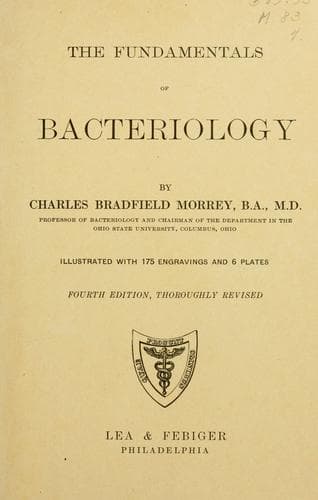
The Fundamentals of BacteriologyMorrey, Charles Bradfield
Science
The Fundamentals of Bacteriology
Morrey, Charles Bradfield
Bacteriology
Careful experimenters have shown that the electric current, either
direct or alternating, has no direct destructive effect on bacteria.
In a liquid medium the organisms may be attracted to or repelled
from one or the other pole or may arrange themselves in definite
ways between the poles (galvanotaxis), but are not injured. However,
electricity through the _secondary_ effects produced, may be used to
destroy bacteria. If the passage of the electric current _increases the
temperature_ of the medium sufficiently, the bacteria will be killed,
or if _injurious chemical substances_ are formed (ozone, chlorine,
acids, bases, etc.), the same result will follow (see Ozone, pp. 77 and
157).
RADIATIONS.
Röntgen or _x_-rays and radium emanations when properly applied to
bacteria will destroy them. The practical use of these agents for
the direct destruction of bacteria in diseases of man or animals is
restricted to those cases where they may be applied directly to the
diseased area, since they are just as injurious to the animal cell
as they are to the bacteria, and even more so. Their skilful use as
_stimuli to the body cells_ to enable them to resist and overcome
bacteria and other injurious organisms or cell growths is an entirely
different function and will not be considered here.
PRESSURE.
Hydrostatic pressure up to about 10,000 pounds per square inch is
without appreciable effect on bacteria as has been shown by several
experimenters and also by finding living bacteria in the ooze dredged
from the bottom of the ocean at depths of several miles.
Pressures from 10,000 to 100,000 pounds show variable effects. Some
bacteria are readily killed and others, even non-spore formers,
are only slightly affected. The time factor is important in this
connection. The presence of acids, even CO₂, or organic acids, results
in the destruction of most non-spore formers.
MECHANICAL VIBRATION.
Vibrations transmitted to bacteria in a liquid may be injurious to them
under certain circumstances. Some of the larger forms like _Bacillus
subtilis_ may be completely destroyed by shaking in a rapidly moving
shaking machine in a few hours. Bacteria in liquids placed on portions
of machinery where only a slight trembling is felt, have been found
to be killed after several days. Reinke has shown that the passing of
strong sound waves through bacterial growths markedly inhibits their
development.
CHAPTER VII.
CHEMICAL ENVIRONMENT.
REACTION OF MEDIUM.
Public-domain text, read in full here on John Shaqi.
Reviews
Reviews
No reviews yet
Be the first to share your thoughts on this work.
Join the Discussion
Join the discussion
Sign in to leave a comment or review.
Sign InorCreate an account