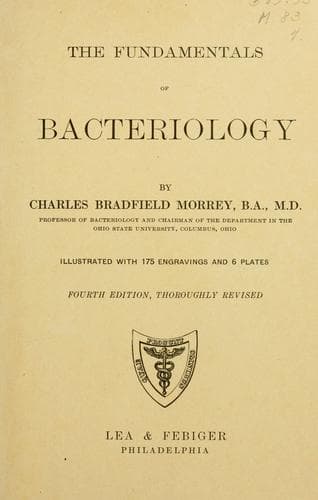
The Fundamentals of BacteriologyMorrey, Charles Bradfield
Science
The Fundamentals of Bacteriology
Morrey, Charles Bradfield
Bacteriology
Bacteriology as a science is a development of the latter half of the
nineteenth century. It may be said to have begun in the decade between
1870 and 1880, due largely to the wide circulation given to Koch’s
work in proving that _Bacillus anthracis_ is the cause of Anthrax in
1876, in devising new culture methods and in demonstrating that wound
infections are due to microörganisms, 1878. Associated with this
work were the great improvements in the microscope by Abbé and the
introduction of anilin dyes for staining bacteria by Weigert. These
results attracted workers throughout the world to the “new science.”
Nevertheless, this work of Koch’s was preceded by numerous observations
and experiments which led up to it. Certainly the most important
discoveries immediately responsible were those of Pasteur. He must be
considered as the greatest of the pioneer bacteriologists since he
worked in all fields of the subject. Some of the antecedent work was
done in attempting to disprove the old “spontaneous generation” theory
as to the origin of organisms; some in searching for the causes of
disease and some in the study of fermentation and putrefaction.
SPONTANEOUS GENERATION.
Speculation as to the first origin of life is as old as history and
doubtless older. Every people of antiquity had its own legends, as for
example, the account in Genesis. This question never can be definitely
settled, even though living matter should be made in the laboratory.
The doctrine of the “spontaneous origin” of particular animals or
plants from dead material under man’s own observation is a somewhat
different proposition and may be subjected to experimental test. The
old Greek philosophers believed it. Anaximander (B.C. 610-547) taught
that some animals are derived from moisture. Even Aristotle (B.C.
384-322) said that “animals sometimes arise in soil, in plants, or
in other animals,” _i.e._, spontaneously. It can be stated that this
belief was general from his day down through the Dark and Middle Ages
and later. Cardano (A.D. 1501-1576) wrote that water gives rise to
fish and animals and is also the cause of fermentation. Van Helmont
(1578-1644) gives directions for making artificial mice. Kircher
(1602-1680) describes and figures animals _produced under his own eyes_
by water on plant stems.
However, many thinkers of the seventeenth century doubted the truth
of this long-established belief. Francesco Redi (1626-1698) made a
number of experiments which tended to prove that maggots did not
arise spontaneously in meat, as was generally believed, but developed
only when flies had an opportunity to deposit their eggs on the
meat. It seems that by the latter part of this century the idea that
organisms large enough to be seen with the naked eye could originate
spontaneously was generally abandoned by learned men.
Public-domain text, read in full here on John Shaqi.
Reviews
Reviews
No reviews yet
Be the first to share your thoughts on this work.
Join the Discussion
Join the discussion
Sign in to leave a comment or review.
Sign InorCreate an account