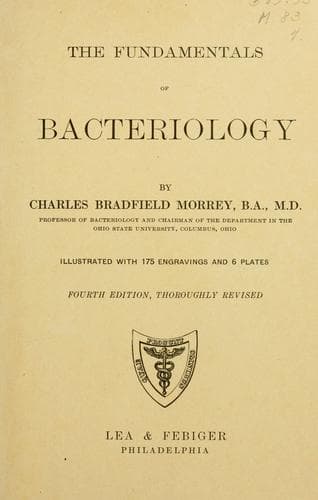
The Fundamentals of BacteriologyMorrey, Charles Bradfield
Science
The Fundamentals of Bacteriology
Morrey, Charles Bradfield
Bacteriology
Experiments have been made by different observers in growing seedling
plants of various kinds in water culture with one or in some cases
several of the amino-acids as sources of nitrogen. Most of these
experiments were disappointing. Plant proteins are not so different
from animal proteins, or plant protoplasm (apart from the chlorophyl
portions of plants) from animal protoplasm as to lead one to suppose
that it could be built up from one or two amino-acids any more than
animal protoplasm can. The author is strongly convinced that this
subject should be thoroughly investigated. It will require careful
experimentation and perhaps rather large funds to provide the amounts
of amino-acids that would probably be needed, but might result in a
decided change in our ideas of soil fertility, and especially in the
use of nitrogen fertilizers.
CHAPTER XII.
PHYSIOLOGICAL ACTIVITIES (CONTINUED).
PRODUCTION OF ENZYMES.
Most of the physiological activities of bacteria which have been
discussed are due to the action of these peculiar substances, so that
a knowledge of their properties is essential. This knowledge cannot as
yet be exact because no enzyme has, up to the present, been obtained in
a “pure state,” though it must be admitted that there are no certain
criteria which will enable this “pure state” to be recognized. It was
formerly thought that they were protein in nature, but very “pure” and
active enzymes have been prepared which did not give the characteristic
protein reactions, so this idea must be abandoned. That they are large
moleculed colloidal substances closely related to the proteins in many
respects must still be maintained. There are certain characteristics
which belong to enzymes, though no one of them exclusively. These may
be enumerated as follows:
1. Enzymes are _dead_ organic chemical substances.
_Dead_ is used in the sense of non-living, never having lived, not in
the sense of “ceased to be alive.”
2. They are always produced by _living_ cells:
Sometimes as active enzymes, sometimes as _pro-enzymes_ or _zymogens_
which are converted into enzymes outside the cell by acids, other
inorganic substances or other enzymes.
3. They produce very great chemical changes without themselves being
appreciably affected.
Enzymes will not continue to act indefinitely, but are used up in the
process (combination with products?). The amount of change is so great
in proportion to the amount of enzyme that the above statement is
justified in the relative sense. Thus a milk-curdling enzyme has been
prepared that would precipitate 100,000,000 times its own weight of
caseinogen.
4. Their action is specific in that each enzyme acts on one kind of
chemical substance only, and the products are always the same.
Public-domain text, read in full here on John Shaqi.
Reviews
Reviews
No reviews yet
Be the first to share your thoughts on this work.
Elsewhere in the archive
Join the Discussion
Join the discussion
Sign in to leave a comment or review.
Sign InorCreate an account