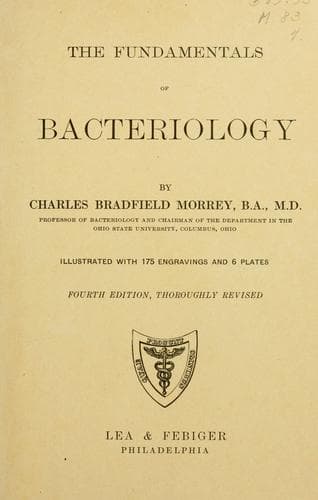
The Fundamentals of BacteriologyMorrey, Charles Bradfield
Science
The Fundamentals of Bacteriology
Morrey, Charles Bradfield
Bacteriology
The substance may be combined with a variety of other chemical
substances so that the action appears to be on several, but in reality
it is on a definite group of molecules in each instance. For example,
emulsin attacks several different glucosides but always sets free
dextrose from them.
5. The action is inhibited and eventually stopped, and in some cases
the enzyme is destroyed by an accumulation of the products of the
action. If the products are removed, the action will continue, if the
enzyme is not destroyed. This effect is explained partly because the
enzyme probably combines with some of the products, since it does
not act indefinitely, and partly because of the reversibility of the
reaction.
6. Like many chemical reactions those of enzymes are reversible, that
is, the substance broken up may be reformed by it from the products
produced in many instances. Thus:
maltose + maltase ⇆ glucose + glucose + maltase.
fat + lipase ⇆ glycerin + fatty acid + lipase.
7. The presence of certain mineral salts seems to be essential for
their action. These and other substances which are necessary are
sometimes called _co-enzymes_. A salt of calcium is most favorable for
a great many.
8. They may be adsorbed like other colloids by “shaking out” with
finely divided suspensions like charcoal or kaolin, or by other
colloids like aluminum hydroxide or proteins.
9. When properly introduced into the tissues or blood of an animal,
they cause the body cells to form _anti-enzymes_ which will prevent the
action of the enzyme (see Chapter XXVII).
10. Though inert, they show many of the characteristics of living
organisms, that is
(_a_) Each enzyme has an optimum, a maximum and a minimum temperature
for its action.
All chemical reactions have such temperature limits, the distinction
is that for enzymes as for living substance the _range_ is relatively
narrow.
(_b_) High temperatures destroy enzymes. All in water are destroyed
by boiling in time and most at temperatures considerably below the
boiling-point. When dry, many will withstand a higher degree of heat
than 100° before they are destroyed.
(_c_) Temperatures below the minimum stop their action, though they are
not destroyed by cold.
(_d_) Many poisons and chemical disinfectants (Chapter XIV) which kill
living organisms will also stop the action of enzymes, though generally
more of the substance is required, so that it is possible to destroy
the living cells by such means and yet the action of the enzyme will
continue.
(_e_) Most enzymes have an optimum reaction of medium either acid,
alkaline or neutral, depending on the particular enzyme, though some
few seem to act equally well within a considerable range on either side
of the neutral point.
_The final test for an enzyme is the chemical change it brings about in
the specific substance acted on._
Public-domain text, read in full here on John Shaqi.
Reviews
Reviews
No reviews yet
Be the first to share your thoughts on this work.
Elsewhere in the archive
Join the Discussion
Join the discussion
Sign in to leave a comment or review.
Sign InorCreate an account