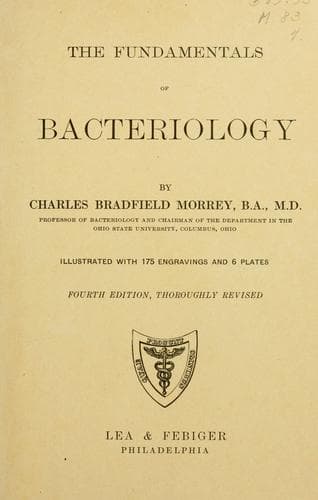
The Fundamentals of BacteriologyMorrey, Charles Bradfield
Science
The Fundamentals of Bacteriology
Morrey, Charles Bradfield
Bacteriology
_“Coagulases” or coagulating enzymes_ as the rennet (lab, chymosin)
which curdles milk; fibrin ferment (thrombin, thrombase) which causes
the coagulation of blood. These apparently act by splitting up a
substance in the fluids mentioned, after which splitting one of the
new products formed combines with other compounds present (usually a
mineral salt, and in the cases mentioned a calcium salt) to form an
insoluble compound, the curd or coagulum.
_Another variety is the “activating” enzymes or “kinases”_ such as the
enterokinase of the intestine. The action here is a splitting of the
_zymogen_ or mother substance or form in which the enzyme is built up
by the cell so as to liberate the active enzyme.
Of a character quite distinct, from the splitting enzymes are
II. The _zymases_. Their action seems to be to cause a “shifting on
rearrangement of the carbon atoms” so that new compounds are formed
which are not assumed to have been constituents of the original
molecule. Most commonly there is a closer combination of the carbon and
oxygen atoms, frequently even the formation of CO₂ so that considerable
energy is thus liberated. Examples are the _zymase_ or _alcoholase_ of
yeast which converts sugar into alcohol and carbon dioxide; C₆H₁₂O₆
= 2C₂H₆O + 2CO₂: also _urease_, which causes the change of urea into
ammonia and carbon dioxide. Another common zymase is the _lactacidase_
in lactic acid fermentation.
III. _Oxidizing enzymes_ also play an important part in many of the
activities of higher plants and animals. Among the bacteria this action
is illustrated by the formation of nitrites, nitrates and sulphates and
the oxidation of alcohol to acetic acid as already described.
IV. _Reducing enzymes_ occur in many of the dentrifying bacteria and
in those which liberate H₂S from sulphates. A very widely distributed
reducing enzyme is “catalase” which decomposes hydrogen peroxide.
As previously stated, most of the physiological activities of
bacteria are due to the enzymes that they produce. It is evident
that for action to occur on substances which do not diffuse into the
bacterial cell--starches, cellulose, complex proteins, gelatin--the
enzymes must _pass out_ of the bacterium and consequently may be
found in the surrounding medium. Substances like sugars, peptones,
alcohol, which are readily diffusible, may be acted on by enzymes
_retained within_ the cell body. In the former case the enzymes are
spoken of as extra-cellular or “_exo-enzymes_,” and in the latter as
intra-cellular or “_endo-enzymes_.” The endo-enzymes and doubtless also
the exo-enzymes may after the death of the cell digest the contents
to a greater or less extent and thus furnish substances that are
not otherwise obtainable. This process of “self-digestion” is known
technically as “_autolysis_.”
Public-domain text, read in full here on John Shaqi.
Reviews
Reviews
No reviews yet
Be the first to share your thoughts on this work.
Elsewhere in the archive
Join the Discussion
Join the discussion
Sign in to leave a comment or review.
Sign InorCreate an account