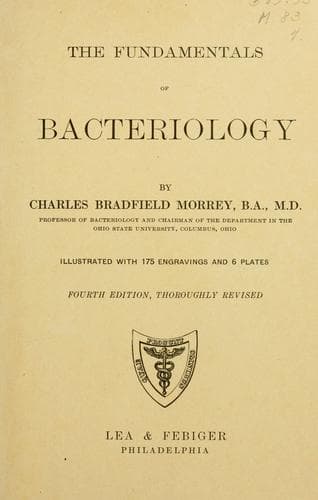
The Fundamentals of BacteriologyMorrey, Charles Bradfield
Science
The Fundamentals of Bacteriology
Morrey, Charles Bradfield
Bacteriology
=Bichloride of Mercury.=--Bichloride of mercury, _mercuric chloride,
corrosive sublimate_ (HgCl₂), is the strongest of all disinfectants
under proper conditions. It is also extremely poisonous to men and
animals and great care is necessary in its use. It is precipitated by
albuminous substances and attacks metallic objects, hence should not be
used in the presence of these classes of substances.
It is used in a strength of one part HgCl₂ to 1000 of water for general
disinfection. Ammonium chloride or sodium chloride, common salt, in
quantities equal to the bichloride, or citric acid in one-half of the
amount should be added in making large quantities of solution or for
use with albuminous fluids to prevent precipitation of the mercury
(Fig. 109).
None of the other metallic salts are of value as practical
disinfectants aside from their use in surgical practice. In this
latter class come boric acid, silver nitrate, potassium permanganate.
The strong mineral acids and alkalies are, of course, destructive to
bacteria, but their corrosive effect excludes them from practical use,
except that “lye washes” are of value in cleaning floors and rough
wood-work, but even here better _disinfection_ can be done more easily
and safely.
[Illustration: FIG. 109.--Tanks for bichloride of mercury, government
quarantine disinfecting plant.]
ORGANIC COMPOUNDS.
=Carbolic Acid or Phenol.=--Carbolic acid or phenol (C₆H₅ OH) is one
of the commonest agents in this class. It is used mostly in 5 per
cent. solution as a disinfectant and in 0.5 per cent. solution as an
antiseptic. For use in large quantities the crude is much cheaper and,
according to some experimenters, even more active than the pure acid,
owing to the cresols it contains. The crude acid is commonly mixed with
an equal volume of commercial sulphuric acid and the mixture is added
to enough water to make a 5 per cent. dilution, which is stronger than
either of the ingredients alone in 5 per cent. solution.
=Cresols.=--The cresols (C₆H₄CH₃OH, ortho, meta and para), coal-tar
derivatives, as phenol, are apparently more powerful disinfectants.
A great number of preparations containing them have been put on the
market. _Creolin_ is one which is very much used in veterinary practice
and forms a milky fluid with water, while _lysol_ forms a clear frothy
liquid owing to the presence of soap. Both of these appear to be more
active than carbolic acid and are less poisonous and more agreeable to
use. They are used in 2 to 5 per cent. solution.
=Alcohol.=--Ordinary (ethyl) alcohol (C₂H₅OH) is largely used as a
_preservative_, also as a disinfectant for the body surface, hands, and
arms. Experiments show that alcohol of 70 per cent. strength is most
strongly bactericidal and that absolute alcohol is very slightly so.
Public-domain text, read in full here on John Shaqi.
Reviews
Reviews
No reviews yet
Be the first to share your thoughts on this work.
Elsewhere in the archive
Join the Discussion
Join the discussion
Sign in to leave a comment or review.
Sign InorCreate an account