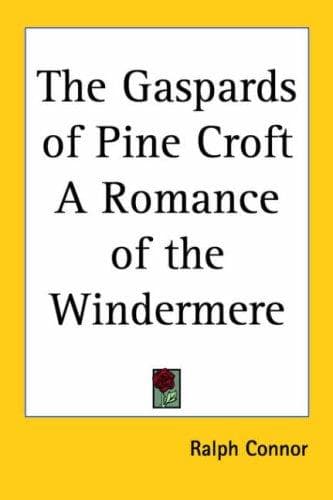
The Gaspards of Pine Croft: A Romance of the WindermereConnor, Ralph
General
The Gaspards of Pine Croft: A Romance of the Windermere
Connor, Ralph
British Columbia -- Fiction; Canadian fiction -- 20th century
Meantime the pinto and his rider had tracked the others up to the Pine
Croft bungalow, along the upper trail, and down again toward the big
rapid. To Paul, who for the past two years had been trained in sign
reading by Indian Tom, his father’s ancient factotum, the trail lay
plain as the open road. After the first wild gallop he was in no hurry
to catch up. The glory of the early June day filled his world, right up
to the blue sky. With his eyes open to the unending variety of colour
and form in the growing things about him, he cantered slowly along, his
lithe form swaying in unison with every motion of his pony. He had the
make of a rider and his style was a curious mixture of his father’s and
Indian Tom’s. His hands were his father’s; the easy yielding sway of his
body he had from Indian Tom. But, whatever its source, every movement of
every part of his body was smooth, easy, graceful. As the pinto carried
him along in swallow-like movement, his mind following his eye went
first to the pictures that kept composing and dissolving themselves on
either side, and from them to those pictures which from his earliest
years he had watched his father call into being in his studio. Where was
his father now? For three years there had been silence, from that
dreadful day when his father, gaunt, broken, his great frame heaving
with deep-drawn sobs, had ridden down the Golden trail, followed by
Indian Tom, leaving him with Colonel Pelham. Two words only had his
father spoken, two unforgettable words. “Paul, your mother has gone to
God. Let every morning bring back to you her words.” And the other,
“Some day I will come back to you—point of honour,” using a phrase
common to those three when the word was pledged. Those two words he
carried in his heart. With every opening dawn his first thoughts went to
his mother. He was dismayed to find how few were his mother’s words that
came to him as he sat down deliberately to recall them. To his delight
he stumbled upon a plan. When struggling with his Catechism—it was a
point of honour that he should complete the task his mother had not seen
completed—he found upon reviewing the questions he had discussed with
her that floods of memories were let loose upon his mind. With painful
care, for, though he had his father’s fingers and was clever with them,
he had made no very great progress with his penmanship, he undertook to
set down, in one of his father’s sketch books, all her sayings that came
back to him. The words associated with the Bible stories were much
easier to recall. The chirography and orthography would have quite
paralysed the intelligence of learned experts, but to himself the record
was perfectly intelligible, and with its increasing volume became an
increasingly precious possession. This record he kept hidden from mortal
eyes, but somehow he had the conviction both God and his mother knew all
about it. The two were very really and vitally associated in his
thought.
Public-domain text, read in full here on John Shaqi.
Reviews
Reviews
No reviews yet
Be the first to share your thoughts on this work.
Join the Discussion
Join the discussion
Sign in to leave a comment or review.
Sign InorCreate an account