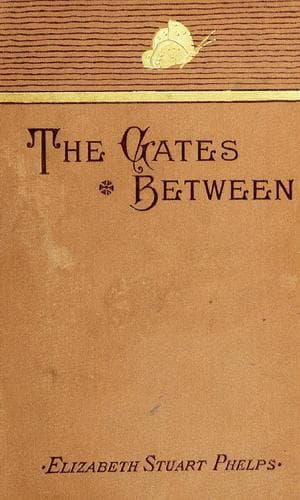
Christian fiction; Future life -- Fiction; Spiritualism -- Fiction
In order to give force to my narrative, it will be necessary for me to
be more personal in some particulars than I could have chosen, and to
revert to certain details of my early history belonging to that
category which people of my profession or temperament are wont to
dismiss as "emotional." I have had strange occasion to learn that this
is a deep and delicate word, which can never be scientifically used,
which cannot be so much as elementally understood, except by delicacy
and by depth. These are precisely the qualities of which this is to be
said,--he who most lacks them will be most unaware of the lack.
There is a further peculiarity about such unconsciousness; that it is
not material for education. You can teach a man that he is not
generous, or true, or able. You can never teach him that he is
superficial, or that he is not fine.
I have been by profession a physician; the son of a chemist; the
grandson of a surgeon; a man fairly illustrative of the subtler
significance of these circumstances; born and bred, as the children of
science are;--a physical fact in a world of physical facts; a man who
rises, if ever, by miracle, to a higher set of facts; who thinks the
thought of his father, who does the deed of his father's father, who
contests the heredity of his mother, who shuts the pressure of his
special education like a clasp about his nature, and locks it down with
the iron experience of his calling.
It was given to me, as it is not given to all men of my kind, to know a
woman strong enough--and sweet enough--to fit a key unto this lock.
Strong enough _or_ sweet enough, I should rather have said. The two
are truly the same. The old Hebrew riddle read well, that "out of
strength shall come forth sweetness." There is the lioness behind the
rarest honey.
Like others of my calling, I had seen the best and the worst and the
most of women. The pathological view of that complex subject is the
most unfortunate which a man can well have. The habit of classifying a
woman as neuralgic, hysteric, dyspeptic, instead of unselfish,
intellectual, high-minded, is not a wholesome one for the classifier.
Something of the abnormal condition of the _clientele_ extends to the
adviser. A physician who has a healthy and natural view of women has
the making of a great man in him.
I was not a great man. I was only a successful lector; more conscious
in those days of the latter fact, and less of the former, be it
admitted, than I am now. A man's avocation may be at once his ruin and
his exculpation. I do not know whether I was more self-confident or
even more wilful than other men to whom is given the autocracy of our
profession, and the dependence of women which accompanies it. I should
not wish to have the appearance of saying an unmanly thing, if I add
that this dependence had wearied me.
Public-domain text, read in full here on John Shaqi.
Reviews
Reviews
No reviews yet
Be the first to share your thoughts on this work.
Join the Discussion
Join the discussion
Sign in to leave a comment or review.
Sign InorCreate an account