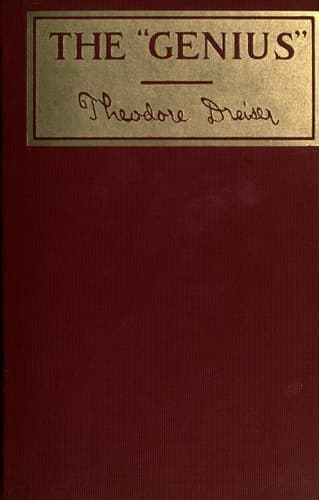
Artists -- Relations with women -- Fiction; Artists -- United States -- Fiction
This trip, so exceptional to him, so epoch-making, was easily arranged.
All the time he had been in New York he had heard more in his circle of
Paris than of any other city. Its streets, its quarters, its museums,
its theatres and opera were already almost a commonplace to him. The
cost of living, the ideal methods of living, the way to travel, what to
see--how often he had sat and listened to descriptions of these things.
Now he was going. Angela took the initiative in arranging all the
practical details--such as looking up the steamship routes, deciding on
the size of trunks required, what to take, buying the tickets, looking
up the rates of the different hotels and pensions at which they might
possibly stay. She was so dazed by the glory that had burst upon her
husband's life that she scarcely knew what to do or what to make of it.
"That Mr. Bierdat," she said to Eugene, referring to one of the
assistant steam-ship agents with whom she had taken counsel, "tells me
that if we are just going for the summer it's foolish to take anything
but absolute necessaries. He says we can buy so many nice little things
to wear over there if we need them, and then I can bring them back duty
free in the fall."
Eugene approved of this. He thought Angela would like to see the shops.
They finally decided to go via London, returning direct from Havre, and
on the tenth of May they departed, arriving in London a week later and
in Paris on the first of June. Eugene was greatly impressed with London.
He had arrived in time to miss the British damp and cold and to see
London through a golden haze which was entrancing. Angela objected to
the shops, which she described as "punk," and to the condition of the
lower classes, who were so poor and wretchedly dressed. She and Eugene
discussed the interesting fact that all Englishmen looked exactly alike,
dressed, walked, and wore their hats and carried their canes exactly
alike. Eugene was impressed with the apparent "go" of the men--their
smartness and dapperness. The women he objected to in the main as being
dowdy and homely and awkward.
Public-domain text, read in full here on John Shaqi.
Reviews
Reviews
No reviews yet
Be the first to share your thoughts on this work.
Elsewhere in the archive
Join the Discussion
Join the discussion
Sign in to leave a comment or review.
Sign InorCreate an account