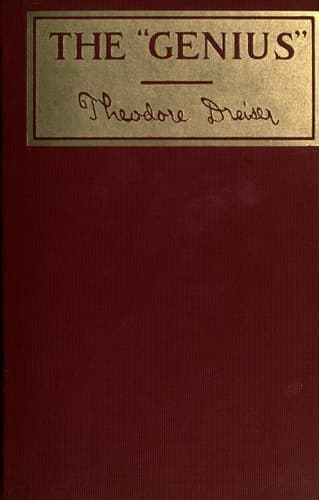
Artists -- Relations with women -- Fiction; Artists -- United States -- Fiction
But when he reached Paris, what a difference! In London, because of the
lack of sufficient means (he did not feel that as yet he had sufficient
to permit him to indulge in the more expensive comforts and pleasures of
the city) and for the want of someone to provide him with proper social
introductions, he was compelled to content himself with that
superficial, exterior aspect of things which only the casual traveler
sees--the winding streets, the crush of traffic, London Tower, Windsor
Castle, the Inns of court, the Strand, Piccadilly, St. Paul's and, of
course, the National Gallery and the British Museum. South Kensington
and all those various endowed palaces where objects of art are displayed
pleased him greatly. In the main he was struck with the conservatism of
London, its atmosphere of Empire, its soldiery and the like, though he
considered it drab, dull, less strident than New York, and really less
picturesque. When he came to Paris, however, all this was changed. Paris
is of itself a holiday city--one whose dress is always gay, inviting,
fresh, like one who sets forth to spend a day in the country. As Eugene
stepped onto the dock at Calais and later as he journeyed across and
into the city, he could feel the vast difference between France and
England. The one country seemed young, hopeful, American, even foolishly
gay, the other serious, speculative, dour.
Eugene had taken a number of letters from M. Charles, Hudson Dula, Louis
Deesa, Leonard Baker and others, who, on hearing that he was going, had
volunteered to send him to friends in Paris who might help him. The
principal thing, if he did not wish to maintain a studio of his own, and
did wish to learn, was to live with some pleasant French family where he
could hear French and pick it up quickly. If he did not wish to do this,
the next best thing was to settle in the Montmartre district in some
section or court where he could obtain a nice studio, and where there
were a number of American or English students. Some of the Americans to
whom he had letters were already domiciled here. With a small calling
list of friends who spoke English he would do very well.
"You will be surprised, Witla," said Deesa to him one day, "how much
English you can get understood by making intelligent signs."
Eugene had laughed at Deesa's descriptions of his own difficulties and
successes, but he found that Deesa was right. Signs went very far and
they were, as a rule, thoroughly intelligible.
Public-domain text, read in full here on John Shaqi.
Reviews
Reviews
No reviews yet
Be the first to share your thoughts on this work.
Elsewhere in the archive
Join the Discussion
Join the discussion
Sign in to leave a comment or review.
Sign InorCreate an account