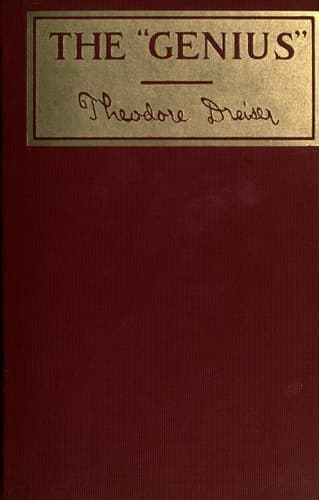
Artists -- Relations with women -- Fiction; Artists -- United States -- Fiction
"I think I'll get Mr. Haverford to transfer me to you, if you'll let me
come," he said at the close of the day when Deegan was taking off his
overalls and the "Eyetalians," as he called them, were putting the
things back in the car.
"Shewer!" said Deegan, impressed by the great name of Haverford. If
Eugene could accomplish that through such a far-off, wondrous
personality, he must be a remarkable man himself. "Come along. I'll be
glad to have ye. Ye can just make out the O. K. blanks and the repoarts
and watch over the min sich times as I'll naat be there and--well--all
told, ye'll have enough to keep ye busy."
Eugene smiled. This was a pleasant prospect. Big John had told him
during the morning that Deegan went up and down the road from Peekskill
on the main line, Chatham on the Midland Division, and Mt. Kisco on a
third branch to New York City. He built wells, culverts, coal bins,
building piers--small brick buildings--anything and everything, in
short, which a capable foreman-mason ought to be able to build, and in
addition he was fairly content and happy in his task. Eugene could see
it. The atmosphere of the man was wholesome. He was like a tonic--a
revivifying dynamo to this sickly overwrought sentimentalist.
That night he went home to Angela full of the humor and romance of his
new situation. He liked the idea of it. He wanted to tell her about
Deegan--to make her laugh. He was destined unfortunately to another kind
of reception.
For Angela, by this time, had endured the agony of her discovery to the
breaking point. She had listened to his pretences, knowing them to be
lies, until she could endure it no longer. In following him she had
discovered nothing, and the change in his work would make the chase more
difficult. It was scarcely possible for anyone to follow him, for he
himself did not know where he would be from day to day. He would be
here, there, and everywhere. His sense of security as well as of his
unfairness made him sensitive about being nice in the unimportant
things. When he thought at all he was ashamed of what he was
doing--thoroughly ashamed. Like the drunkard he appeared to be mastered
by his weakness, and the psychology of his attitude is so best
interpreted. He caressed her sympathetically, for he thought from her
drawn, weary look that she was verging on some illness. She appeared to
him to be suffering from worry for him, overwork, or approaching malady.
Public-domain text, read in full here on John Shaqi.
Reviews
Reviews
No reviews yet
Be the first to share your thoughts on this work.
Elsewhere in the archive
Join the Discussion
Join the discussion
Sign in to leave a comment or review.
Sign InorCreate an account