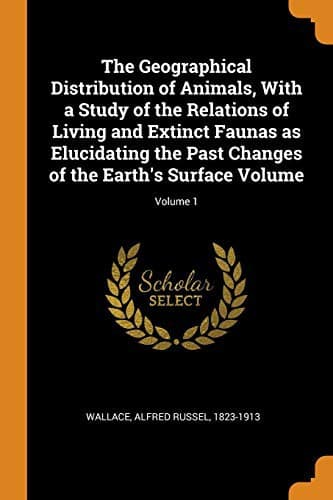
The Geographical Distribution of Animals, Volume 1: With a study of the relations of living and extinct faunas as elucidating the past changes of the Earth's surfaceWallace, Alfred Russel
Science
The Geographical Distribution of Animals, Volume 1: With a study of the relations of living and extinct faunas as elucidating the past changes of the Earth's surface
Wallace, Alfred Russel
Paleontology; Zoogeography
The Bovidæ, or hollow-horned ruminants, were not well represented in
Central Europe in Miocene times. There were no sheep, goats, or oxen, and
only a few antelopes of the genus _Tragocerus_, and one allied to
_Hippotragus_; and these all lived in the Upper Miocene period, as did the
more numerous forms of Greece.
_Proboscidea._--The true elephants do not extend back to the Miocene
period, but they are represented by the Mastodons, which had less complex
teeth. These first appear in the Upper Miocene of Europe, five species
being known from France, Germany, Switzerland, and Greece. _Dinotherium_,
already noticed as occurring in Greece, extended also to Germany and
France, where remains of three species have been found.
_Rodentia._--A considerable number of generic forms of this order have been
obtained from the Miocene strata. The principal genera are _Cricetodon_,
allied to the hamsters, numerous in both the Upper and Lower Miocene period
of France; _Myoxus_ (the dormice) in France, and an allied genus,
_Brachymys_, in Germany. The beavers were represented by the still living
genus _Castor_, and the extinct _Steneofiber_ in France. The squirrels by
the existing _Scuirus_ and _Spermophilus_; and by extinct forms, _Lithomys_
and _Aulacodon_, in Germany, the latter resembling the African genus
_Aulacodes_. The hares, by _Lagomys_ and an {121}extinct form _Titanomys_.
Besides these, remains referred to the South American genera, _Cavia_
(cavy) and _Dasyprocta_ (agouti), have been found, the former in the Upper
Miocene of Switzerland, the latter in the Lower Miocene of Auvergne.
_Palæomys_, allied to the West Indian _Capromys_, has been found in the
same deposits; as well as _Theridomys_, said by Gervais to be allied to
_Anomalurus_ and _Echimys_, the former now living in W. Africa, the latter
in S. America.
_Edentata._--These are only represented by the _Macrotherium_ and
_Ancylotherium_ of the Grecian deposits, the former occurring also in
France and Germany in Upper Miocene strata.
_Marsupials_.--These consist of numerous species related to the opossums
(_Didelphys_), but separated by Gervais under the name _Peratherium_. They
occur in both Upper and Lower Miocene beds.
_Upper Miocene Deposits of the Siwalik Hills and other Localities in N. W.
India._
These remarkable fresh-water deposits form a range of hills at the foot of
the Himalayas, a little south of Simla. They were investigated for many
years by Sir P. Cautley and Dr. Falconer, and add greatly to our knowledge
of the early fauna of the Old World continent.
_Primates_.--Remains of the genera _Semnopithecus_ and _Macacus_ were
found, with other forms of intermediate character; and some teeth indicated
animals allied to the orang-utan of Borneo, and of similar size.
Public-domain text, read in full here on John Shaqi.
Reviews
Reviews
No reviews yet
Be the first to share your thoughts on this work.
Elsewhere in the archive
Join the Discussion
Join the discussion
Sign in to leave a comment or review.
Sign InorCreate an account