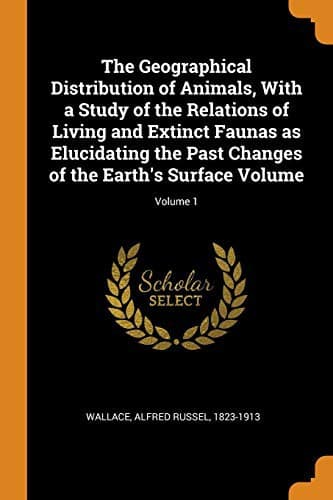
The Geographical Distribution of Animals, Volume 1: With a study of the relations of living and extinct faunas as elucidating the past changes of the Earth's surfaceWallace, Alfred Russel
Science
The Geographical Distribution of Animals, Volume 1: With a study of the relations of living and extinct faunas as elucidating the past changes of the Earth's surface
Wallace, Alfred Russel
Paleontology; Zoogeography
The Miocene is, for our special study, the most valuable and instructive of
the Tertiary periods, both on account of its superior richness, and because
we here meet with many types now confined to separate regions. Such facts
as the occurrence in Europe during this period of hippopotami, tapirs,
giraffes, Tragulidæ, Edentata, and Marsupials--will assist us in solving
many of the problems we shall meet with in reviewing the actual
distribution of living forms of those groups. Still more light will,
however, be thrown on the subject by the fossil forms of the American
continent, which we will now proceed to examine.
{129}CHAPTER VII.
EXTINCT MAMMALIA OF THE NEW WORLD.
The discoveries of very rich deposits of mammalian remains in various parts
of the United States have thrown great light on the relations of the faunas
of very distant regions. North America now makes a near approach to Europe
in the number and variety of its extinct mammalia, and in no part of the
world have such perfect specimens been discovered. In what are called the
"Mauvaises terres" of Nebraska (the dried-up mud of an ancient lake),
thousands of entire crania and some almost entire skeletons of ancient
animals have been found, their teeth absolutely perfect, and altogether
more resembling the preparations of the anatomist, than time-worn fossils
such as we are accustomed to see in the museums of Europe. Other deposits
have been discovered in Oregon, California, Virginia, South Carolina,
Texas, and Utah, ranging over all the Tertiary epochs, from Post-Pliocene
to Eocene, and furnishing a remarkable picture of the numerous strange
mammalia which inhabited the ancient North American continent.
NORTH AMERICA--POST-PLIOCENE PERIOD.
_Insectivora._--The only indications of this order yet discovered, consists
of a single tooth of some insectivorous animal found in Illinois, but which
cannot be referred to any known group.
_Carnivora._--These are fairly represented. Two species of _Felis_ as large
as a lion; the equally large extinct _Trucifelis_, found only in Texas;
four species of _Canis_, some of them larger {130}than wolves; two species
of _Galera_, a genus now confined to the Neotropical region; two bears, and
an extinct genus, _Arctodus_; an extinct species of racoon (_Procyon_), and
an allied extinct genus, _Myxophagus_--show, that at a very recent period
North America was better supplied with Carnivora than it is now. Remains of
the walrus (_Trichechus_) have also been found as far south as Virginia.
_Cetacea._--Three species of dolphins belonging to existing genera, have
been found in the Eastern States; and two species of _Manatus_, or sea-cow,
in Florida and South Carolina.
Public-domain text, read in full here on John Shaqi.
Reviews
Reviews
No reviews yet
Be the first to share your thoughts on this work.
Elsewhere in the archive
Join the Discussion
Join the discussion
Sign in to leave a comment or review.
Sign InorCreate an account