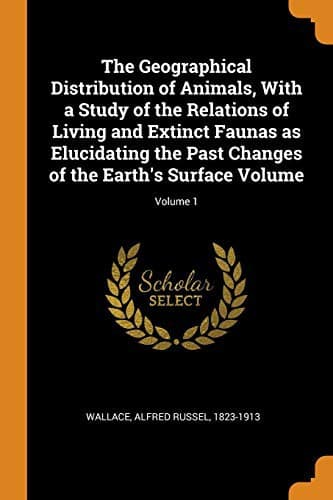
The Geographical Distribution of Animals, Volume 1: With a study of the relations of living and extinct faunas as elucidating the past changes of the Earth's surfaceWallace, Alfred Russel
Science
The Geographical Distribution of Animals, Volume 1: With a study of the relations of living and extinct faunas as elucidating the past changes of the Earth's surface
Wallace, Alfred Russel
Paleontology; Zoogeography
Compared with those of mammalia, the remains of birds are exceedingly
scarce in Europe and America; and from the wandering habits of so many of
this class, they are of much less value {161}as indications of past changes
in physical geography. A large proportion of the remains belong to aquatic
or wading types, and as these have now often a world-wide range, the
occurrence of extinct forms can have little bearing on our present inquiry.
There are, however, a few interesting cases of extinct land-birds belonging
to groups now quite strangers to the country in which they are found; and
others scarcely less interesting, in which groups now peculiar to certain
areas are shown to have been preceded by allied species or genera of
gigantic size.
_Palæarctic Region and N. India._--In the caves and other Post-Pliocene
deposits of these countries, the remains of birds almost all belong to
genera now inhabiting the same districts. Almost the only exceptions are,
the great auk and the capercailzie, already mentioned as being found in the
Danish mounds; the latter bird, with _Tetrao albus_, in Italian caverns;
and a species of pheasant (_Phasianus_) said to have occurred in the
Post-Pliocene of France, considerably west of the existing range of the
genus in a wild state.
In the preceding Pliocene deposits, but few remains have been found, and
all of existing genera but one, a gallinaceous bird (_Gallus bravardi_)
allied to the domestic fowl and peacock.
The Miocene beds of France and Central Europe have produced many more
remains of birds, but these, too, are mostly of existing European genera,
though there are some notable exceptions. Along with forms
undistinguishable from crows (_Corvus_), shrikes (_Lanius_), wagtails
(_Motacilla_), and woodpeckers (_Picus_), are found remains allied to the
Oriental edible-nest swift (_Collocalia_) and _Trogon_; a parrot resembling
the African genus _Psittacus_; an extinct form _Necrornis_, perhaps allied
to the plantain-eaters (_Musophaga_); _Homalophus_, doubtfully allied to
woodpeckers, and _Limnatornis_ to the hoopoes. The gallinaceous birds are
represented by three species of pheasants, some very close to the
domesticated species; _Palæoperdix_ allied to the partridges; and
_Palæortyx_, small birds allied to the American genus _Ortyx_, but with
larger wings. There are also species of _Pterocles_ allied to living birds,
and a small pigeon. There are numerous living genera of Accipitres; such as
eagle (_Aquila_), {162}kite (_Milvus_), eagle-owl (_Bubo_), and screech-owl
(_Strix_); with the African secretary-bird (_Serpentarius_), and some
extinct forms, as _Palæocercus_, _Palæohierix_ and _Palæetus_.
Public-domain text, read in full here on John Shaqi.
Reviews
Reviews
No reviews yet
Be the first to share your thoughts on this work.
Elsewhere in the archive
Join the Discussion
Join the discussion
Sign in to leave a comment or review.
Sign InorCreate an account