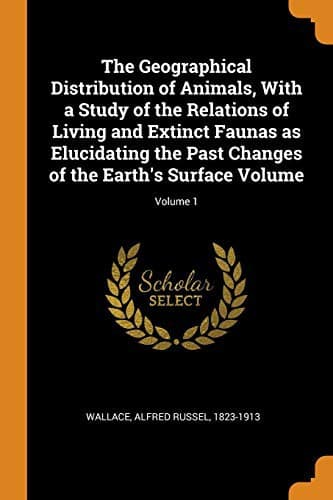
The Geographical Distribution of Animals, Volume 1: With a study of the relations of living and extinct faunas as elucidating the past changes of the Earth's surfaceWallace, Alfred Russel
Science
The Geographical Distribution of Animals, Volume 1: With a study of the relations of living and extinct faunas as elucidating the past changes of the Earth's surface
Wallace, Alfred Russel
Paleontology; Zoogeography
_Azores._--Considering the remoteness of this group from every other land,
it is surprising to find as many as fifty-three species of birds inhabiting
or visiting the Azores; and still more to {207}find that they are of
Palæarctic genera and, with one exception, all of species found either in
Europe, North Africa, Madeira, or the Canaries. The exception is a
bullfinch peculiar to the islands, but closely allied to a European
species. Of land birds there are twenty-two, belonging to twenty-one
genera, all European. These genera are _Cerchneis_, _Buteo_, _Asio_,
_Strix_, _Turdus_, _Oriolus_, _Erithacus_, _Sylvia_, _Regulus_, _Saxicola_,
_Motacilla_, _Plectrophanes_, _Fringilla_, _Pyrrhula_, _Serinus_,
_Sturnus_, _Picus_, _Upupa_, _Columba_, _Caccabis_, and _Coturnix_. Besides
the bullfinch (_Pyrrhula_) other species show slight differences from their
European allies, but not such as to render them more than varieties. The
only truly indigenous mammal is a bat of a European species. Nine
butterflies inhabit the Azores; eight of them are European species, one
North American. Of beetles 212 have been collected, of which no less than
175 are European species; of the remainder, nineteen are found in the
Canaries or Madeira, three in South America, while fourteen are peculiar to
the islands.
Now these facts (for which we are indebted to Mr. Godman's _Natural History
of the Azores_) are both unexpected and exceedingly instructive. In most
other cases of remote Oceanic islands, a much larger proportion of the
fauna is endemic, or consists of peculiar species and often of peculiar
genera; as is well shown by the case of the Galapagos and Juan Fernandez,
both much nearer to a continent and both containing peculiar genera and
species of birds. Now we know that the cause and meaning of this difference
is, that in the one case the original immigration is very remote and has
never or very rarely been repeated, so that under the unchecked influence
of new conditions of life the species have become modified; in the other
case, either the original immigration has been recent, or if remote has
been so frequently repeated that the new comers have kept up the purity of
the stock, and have not allowed time for the new conditions to produce the
effect we are sure they would in time produce if not counteracted. For Mr.
Godman tells us that many of the birds are modified--instancing the
gold-crested wren, blackcap, and rock dove--and he adds, that the
{208}modification all tends in one direction--to produce a more sombre
plumage, a greater strength of feet and legs, and a more robust bill. We
further find, that four of the land-birds, including the oriole,
snow-bunting, and hoopoe, are not resident birds, but straggle accidentally
to the islands by stress of weather; and we are told that every year some
fresh birds are seen after violent storms. Add to this the fact, that the
number of species diminishes in the group as we go from east to west, and
Public-domain text, read in full here on John Shaqi.
Reviews
Reviews
No reviews yet
Be the first to share your thoughts on this work.
Elsewhere in the archive
Join the Discussion
Join the discussion
Sign in to leave a comment or review.
Sign InorCreate an account