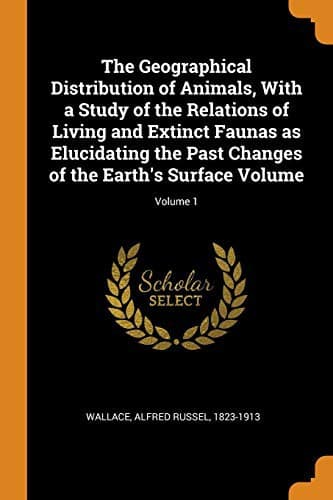
The Geographical Distribution of Animals, Volume 1: With a study of the relations of living and extinct faunas as elucidating the past changes of the Earth's surfaceWallace, Alfred Russel
Science
The Geographical Distribution of Animals, Volume 1: With a study of the relations of living and extinct faunas as elucidating the past changes of the Earth's surface
Wallace, Alfred Russel
Paleontology; Zoogeography
that the islands are subject to fierce and frequent storms blowing from
every point of the compass,--and we have all the facts requisite to enable
us to understand how this remote archipelago has become stocked with animal
life without ever probably being much nearer to Europe than it is now. For
the islands are all volcanic, the only stratified rock that occurs being
believed to be of Miocene date.
_Madeira and the Canaries._--Coming next to Madeira, we find the number of
genera of land birds has increased to twenty-eight, of which seventeen are
identical with those of the Azores. Some of the commonest European
birds--swallows, larks, sparrows, linnets, goldfinches, ravens, and
partridges, are among the additions. A gold-crested warbler, _Regulus
Maderensis_, and a pigeon, _Columba Trocaz_, are peculiar to Madeira.
In the Canaries we find that the birds have again very much increased,
there being more than fifty genera of land birds; but the additions are
wholly European in character, and almost all common European species. We
find a few more peculiar species (five), while some others, including the
wild canary, are common to all the Atlantic Islands or to the Canaries and
Madeira. Here, too, the only indigenous mammalia are two European species
of bats.
_Land Shells._--The land shells of Madeira offer us an instructive contrast
to the birds of the Atlantic Islands. About fifty-six species have been
found in Madeira, and forty-two in the small adjacent island of Porto
Santo, but only twelve are common to both, and all or almost all are
distinct from their nearest allies in Europe and North Africa. Great
numbers of fossil shells are also found in deposits of the Newer Pliocene
period; and {209}although these comprise many fresh species, the two faunas
and that of the continent still remain almost as distinct from each other
as before. It has been already stated (p. 31) that the means by which land
mollusca have been carried across arms of the sea are unknown, although
several modes may be suggested; but it is evidently a rare event, requiring
some concurrence of favourable conditions not always present. The diversity
and specialization of the forms of these animals is, therefore, easily
explained by the fact, that, once introduced they have been left to
multiply under the influence of a variety of local conditions, which
inevitably lead, in the course of ages, to the formation of new varieties
and new species.
Public-domain text, read in full here on John Shaqi.
Reviews
Reviews
No reviews yet
Be the first to share your thoughts on this work.
Elsewhere in the archive
Join the Discussion
Join the discussion
Sign in to leave a comment or review.
Sign InorCreate an account