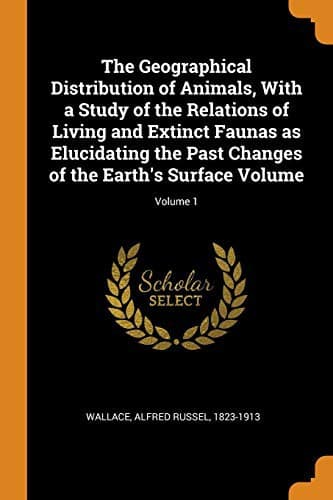
The Geographical Distribution of Animals, Volume 1: With a study of the relations of living and extinct faunas as elucidating the past changes of the Earth's surfaceWallace, Alfred Russel
Science
The Geographical Distribution of Animals, Volume 1: With a study of the relations of living and extinct faunas as elucidating the past changes of the Earth's surface
Wallace, Alfred Russel
Paleontology; Zoogeography
_Coleoptera._--The beetles of Madeira and the Canaries have been so
carefully collected and examined by Mr. T. V. Wollaston, and those of the
Azores described and compared by Mr. Crotch, and they illustrate so many
curious points in geographical distribution, that it is necessary to give
some account of them. No less than 1,480 species of beetles have been
obtained from the Canaries and Madeira, only 360 of which are European, the
remainder being peculiar to the islands. The Canaries are inhabited by a
little over 1,000 species, Madeira by about 700, while 240 are common to
both; but it is believed that many of these have been introduced by man. In
the Azores, 212 species have been obtained, of which 175 are European;
showing, as in the birds, as closer resemblance to the European fauna than
in the other islands which, although nearer to the continent, offer more
shelter and are situated in a less tempestuous zone. Of the non-European
species in the Azores, 19 are found also in the other groups of islands, 14
are peculiar, while 3 are American. Of the European species, 132 are found
also in the other Atlantic islands, while 43 have reached the Azores only.
This is interesting as showing to how great an extent the same insects
reach all the islands, notwithstanding the difference of latitude and
position; and it becomes of great theoretical importance, when we find how
many extensive families and genera are altogether absent.
The Madeira group has been more thoroughly explored than {210}any other,
and its comparatively remote situation, combined with its luxuriant
vegetation, have been favourable to the development and increase of the
peculiar forms which characterize all the Atlantic islands in a more or
less marked degree. A consideration of some of its peculiarities will,
therefore, best serve to show the bearing of the facts presented by the
insect fauna of the Atlantic islands, on the general laws of distribution.
The 711 species of beetles now known from the Madeira group, belong to 236
genera; and no less than 44 of these genera are not European but are
peculiar to the Atlantic islands. Most of them are, however, closely allied
to European genera, of which they are evidently modifications. A most
curious general feature presented by the Madeiran beetles, is the total
absence of many whole families and large genera abundant in South Europe.
Such are the Cicindelidæ, or tiger beetles; the Melolonthidæ, or chafers;
the Cetoniidæ, or rose-chafers; the Eumolpidæ and Galerucidæ, large
families of Phytophagous, or leaf-eating beetles; and also the extensive
groups of Elateridæ and Buprestidæ, which are each represented by but one
minute species. Of extensive genera abundant in South Europe, but wholly
absent in Madeira, are _Carabus_, _Rhizotrogus_, _Lampyris_, and other
genera of Malacoderms; _Otiorhynchus_, _Brachycerus_, and 20 other genera
of Curculionidæ, comprising more than 300 South European and North African
Public-domain text, read in full here on John Shaqi.
Reviews
Reviews
No reviews yet
Be the first to share your thoughts on this work.
Elsewhere in the archive
Join the Discussion
Join the discussion
Sign in to leave a comment or review.
Sign InorCreate an account