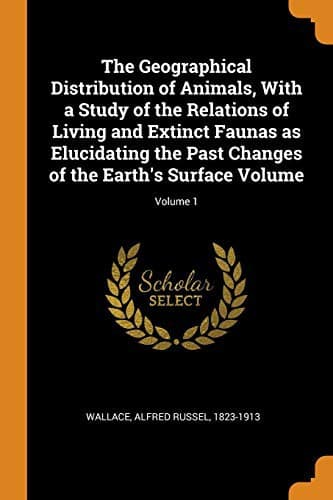
The Geographical Distribution of Animals, Volume 1: With a study of the relations of living and extinct faunas as elucidating the past changes of the Earth's surfaceWallace, Alfred Russel
Science
The Geographical Distribution of Animals, Volume 1: With a study of the relations of living and extinct faunas as elucidating the past changes of the Earth's surface
Wallace, Alfred Russel
Paleontology; Zoogeography
This is an interesting and very productive district, corresponding in the
east to the Mediterranean sub-region in the west, or rather perhaps to all
western temperate Europe. Its limits are not very well defined, but it
probably includes all Japan; the Corea and Manchuria to the Amour river and
to the lower {221}slopes of the Khingan and Peling mountains; and China to
the Nanlin mountains south of the Yang-tse-kiang. On the coast of China the
dividing line between it and the Oriental region seems to be somewhere
about Foo-chow, but as there is here no natural barrier, a great
intermingling of northern and southern forms takes place.
Japan is volcanic and mountainous, with a fine climate and a most luxuriant
and varied vegetation. Manchuria is hilly, with a high range of mountains
on the coast, and some desert tracts in the interior, but fairly wooded in
many parts. Much of northern China is a vast alluvial plain, backed by
hills and mountains with belts of forest, above which are the dry and
barren uplands of Mongolia. We have a tolerable knowledge of China, of
Japan, and of the Amoor valley, but very little of Corea and Manchuria. The
recent researches of Père David in Moupin, in east Thibet, said to be
between 31° and 32° north latitude, show, that the fauna of the Oriental
region here advances northward along the flanks of the Yun-ling mountains
(a continuation of the Himalayas); since he found at different altitudes
representatives of the Indo-Chinese, Manchurian, and Siberian faunas. On
the higher slopes of the Himalayas, there must be a narrow strip from about
8,000 to 11,000 feet elevation intervening between the tropical fauna of
the Indo-Chinese sub-region and the almost arctic fauna of Thibet; and the
animals of this zone will for the most part belong to the fauna of
temperate China and Manchuria, except in the extreme west towards Cashmere,
where the Mediterranean fauna will in like manner intervene. On a map of
sufficiently large scale, therefore, it would be necessary to extend our
present sub-region westward along the Himalayas, in a narrow strip just
below the upper limits of forests. It is evident that the large number of
Fringillidæ, Corvidæ, Troglodytidæ, and Paridæ, often of south Palæarctic
forms, that abound in the higher Himalayas, are somewhat out of place as
members of the Oriental fauna, and are equally so in that of Thibet and
Siberia; but they form a natural portion of that of North China on the one
side, or of South Europe on the other.
Public-domain text, read in full here on John Shaqi.
Reviews
Reviews
No reviews yet
Be the first to share your thoughts on this work.
Elsewhere in the archive
Join the Discussion
Join the discussion
Sign in to leave a comment or review.
Sign InorCreate an account