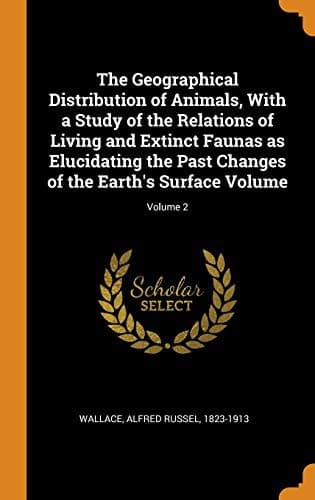
The Geographical Distribution of Animals, Volume 2: With a study of the relations of living and extinct faunas as elucidating the past changes of the Earth's surface — John Shaqi
The Geographical Distribution of Animals, Volume 2: With a study of the relations of living and extinct faunas as elucidating the past changes of the Earth's surfaceWallace, Alfred Russel
Science
The Geographical Distribution of Animals, Volume 2: With a study of the relations of living and extinct faunas as elucidating the past changes of the Earth's surface
Wallace, Alfred Russel
Paleontology; Zoogeography
_General Zoological Features of the Neotropical Region._--Richness combined
with isolation is the predominant feature of Neotropical zoology, and no
other region can approach it in the number of its peculiar family and
generic types. It has eight families of Mammalia absolutely confined to it,
besides several others which are rare elsewhere. These consist of two
families of monkeys, Cebidæ and Hapalidæ, both abounding in genera and
species; the Phyllostomidæ, or blood-sucking bats; Chinchillidæ and Caviidæ
among rodents; besides the greater part of the Octodontidæ, Echimyidæ and
Cercolabidæ. Among edentata, it has Bradypodidæ, or sloths, Dasypodidæ, or
armadillos, and Myrmecophagidæ, or anteaters, constituting nearly the
entire order; while Procyonidæ, belonging to the carnivora, and
Didelphyidæ, a family of marsupials, only extend into the Nearctic region.
It has also many peculiar groups of carnivora and of Muridæ, making a total
of full a hundred genera confined to the region. Hardly less remarkable is
the absence of many wide-spread groups. With the exception of one genus in
the West Indian islands and a _Sorex_ which reaches Guatemala and Costa
Rica, the Insectivora are wholly wanting; as is also the extensive and
wide-spread family of the Viverridæ. It has no oxen or sheep, and indeed no
form of ruminant except deer and llamas; neither do its vast forests and
grassy plains support a single form of non-ruminant ungulate, except the
tapir and the peccary.
{6}_Birds._--In birds, the Neotropical region is even richer and more
isolated. It possesses no less than 23 families wholly confined within its
limits, with 7 others which only extend into the Nearctic region. The names
of the peculiar families are: Cærebidæ, or sugar-birds; Phytotomidæ, or
plant-cutters; Pipridæ, or manakins; Cotingidæ, or chatterers;
Formicariidæ, or ant-thrushes; Dendrocolaptidæ, or tree-creepers;
Pteroptochidæ; Rhamphastidæ, or toucans; Bucconidæ, or puff-birds;
Galbulidæ, or jacamas; Todidæ, or todies; Momotidæ, or motmots;
Steatornithidæ, the guacharo, or oil-bird; Cracidæ, or curassows; Tinamidæ,
or tinamous; Opisthocomidæ, the hoazin; Thinocoridæ; Cariamidæ; Aramidæ;
Psophiidæ, or trumpeters; Eurypygidæ, or sun-bitterns; and Palamedeidæ, or
horned-screamers. The seven which it possesses in common with North America
are: Vireonidæ, or greenlets; Mniotiltidæ, or wood-warblers; Tanagridæ, or
tanagers; Icteridæ, or hang-nests; Tyrannidæ, or tyrant-shrikes;
Trochilidæ, or humming-birds; and Conuridæ, or macaws. Most of these
families abound in genera and species, and many are of immense extent; such
as Trochilidæ, with 115 genera, and nearly 400 species; Tyrannidæ, with
more than 60 genera and nearly 300 species; Tanagridæ, with 43 genera and
300 species; Dendrocolaptidæ with 43 genera and more than 200 species; and
many other very large groups. There are nearly 600 genera peculiar to the
Neotropical region; but in using this number as a basis of comparison with
Public-domain text, read in full here on John Shaqi.
Reviews
Reviews
No reviews yet
Be the first to share your thoughts on this work.
Join the Discussion
Join the discussion
Sign in to leave a comment or review.
Sign InorCreate an account