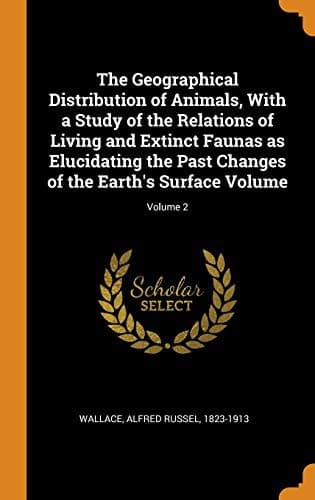
The Geographical Distribution of Animals, Volume 2: With a study of the relations of living and extinct faunas as elucidating the past changes of the Earth's surfaceWallace, Alfred Russel
Science
The Geographical Distribution of Animals, Volume 2: With a study of the relations of living and extinct faunas as elucidating the past changes of the Earth's surface
Wallace, Alfred Russel
Paleontology; Zoogeography
The southern temperate portion of the continent, has probably had a
considerable southward extension in late Tertiary times; and this, as well
as the comparatively recent elevation of the Andes, has given rise to some
degree of intermixture of two distinct faunas, with that proper to South
Temperate America itself. The most important of these, is the considerable
Australian element that appears in the insects, and even in the reptiles
and fresh-water fishes, of South Temperate America. These may be traced to
several causes. Icebergs and icefloes, and even solid fields of ice, may,
during the Glacial epoch, have afforded many opportunities for the passage
of the more cold-enduring groups; while the greater extension of southern
lands and islands during the warm periods--which there is reason to believe
prevailed in the southern as well as in the northern regions in Miocene
times--would afford facilities for the passage of the reptiles and insects
of more temperate zones. That no actual land-connection occurred, is proved
by the total absence {83}of interchange of the mammals or land-birds of the
two countries, no less than by the very fragmentary nature of the
resemblances that do exist. The northern element consists almost wholly of
insects; and is evidently due to the migration of arctic and north
temperate forms along the ridges and plateaus of the Andes; and most likely
occurred when these organisms were driven southward at successive cold or
Glacial periods.
A curious parallel exists between the past history and actual zoological
condition of South America and Africa. In both we see a very ancient
land-area extending into the South Temperate zone, isolated at a very early
period, and developing only a low grade of Mammalian life; chiefly
Edentates and Rodents on the one, Lemurs and Insectivora in the other.
Later we find an irruption into both of higher forms, including Quadrumana,
which soon acquired a large and special development in the tropical
portions of each country. Still later we have an irruption into both of
northern forms, which spread widely over the two regions, and having become
extinct in the land from whence they came, have been long held to be the
original denizens of their adopted country. Such are the various forms of
antelopes, the giraffe, the elephant, rhinoceros, and lion in Africa; while
in America we have deer and peccaries, the tapir, opossums, and the puma.
On the whole, we cannot but consider that the broad outlines of the
zoological history of the Neotropical region can be traced with some degree
of certainty; but, owing to the absence of information as to the most
important of the geological periods--the Miocene and Eocene--we have no
clue to the character of its early fauna, or to the land connections with
other countries, which may possibly have occurred in early Tertiary times.
{84}TABLES OF DISTRIBUTION.
Public-domain text, read in full here on John Shaqi.
Reviews
Reviews
No reviews yet
Be the first to share your thoughts on this work.
Elsewhere in the archive
Join the Discussion
Join the discussion
Sign in to leave a comment or review.
Sign InorCreate an account