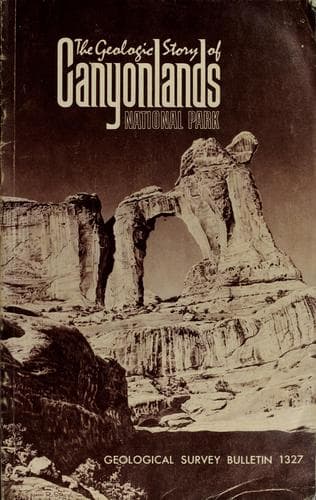
The Geologic Story of Canyonlands National ParkLohman, Stanley William
Science
The Geologic Story of Canyonlands National Park
Lohman, Stanley William
Canyonlands National Park (Utah) -- Guidebooks; Geology -- Utah -- Canyonlands National Park -- Guidebooks
There are at least three periods of workmanship visible on the rock.
The last is quite recent since it shows men mounted on horses [brought
in by Spanish explorers]. These are probably less than 200 years old
and are probably the work of Ute tribesmen. The others cannot be
identified with any specific cultural group, although the earliest may
be as much as one thousand years old and are probably the work of the
so-called “Fremont” peoples * * *
In addition to the designs by the Fremont, Anasazi, and Ute artists, you
will note a few names and dates as late as 1954.
[Illustration: Petroglyph]
[Illustration: NEWSPAPER ROCK, petroglyphs cut in Wingate Sandstone
cliff in Indian Creek State Park. Inscriptions probably span about
1,000 years and include figures by Fremont, Anasazi, and Ute people
(mounted horsemen) and by a few early white settlers. (Fig. 5)]
Late arrivals
The modern history of Canyonlands is as colorful as the canyons
themselves, and involves Indians, cattlemen, bank robbers, cattle
rustlers, and horsethieves, followed by oil drillers, uranium hunters,
potash miners, jeepsters, boaters, and tourists. A brief summary of
their activities is taken mainly from a recent account by Maxine Newell
(1970), to whose work you are referred for further details.
Bands of Ute and Navajo Indians roamed the canyons and mesas until the
late 1800’s, but gradually they were driven out and succeeded by pioneer
cattlemen, the first of whom were George and Silas Green in 1874-75,
followed by the Taylor brothers in 1880-81. Cowboys named many of the
natural features of the area, and the Needles country provided the
scenic background for some of Zane Grey’s western tales and for David
Lavender’s “One Man’s West.” Lavender Canyon, whose headwaters were
recently annexed to the park, was named for him. Visitors to the Needles
district pass the Dugout Ranch about 7 miles northwest of Newspaper
Rock. The earliest ranch dwellings were dirt houses built by the
Somerville and Scorup brothers, who bought the huge Indian Creek spread
for $426,000 from the Carlisle Co. in 1918. In 1973 the ranch was
operated by Robert and Heidi Redd, whose line camp at Cave Spring served
as temporary park headquarters and later was restored to a typical line
camp (fig. 6) as part of the Cave Spring Environmental Trail.
Public-domain text, read in full here on John Shaqi.
Reviews
Reviews
No reviews yet
Be the first to share your thoughts on this work.
Join the Discussion
Join the discussion
Sign in to leave a comment or review.
Sign InorCreate an account