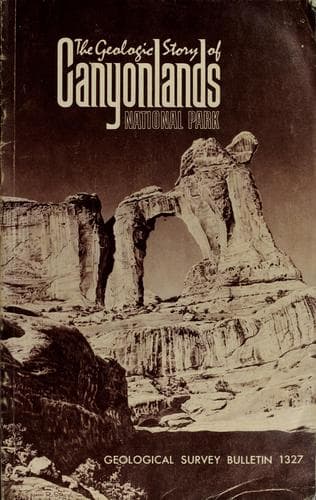
The Geologic Story of Canyonlands National ParkLohman, Stanley William
Science
The Geologic Story of Canyonlands National Park
Lohman, Stanley William
Canyonlands National Park (Utah) -- Guidebooks; Geology -- Utah -- Canyonlands National Park -- Guidebooks
First among these events was the piling up, layer upon layer, of
thousands of feet of sedimentary rocks under a wide variety of
environments. Sedimentary rocks of the region are composed of particles
ranging in size from clay and silt through sand and gravel carried to
their resting places by moving water, silt and sand particles
transported by wind, and some materials precipitated from water
solutions, such as limestone (calcium carbonate), dolomite (calcium and
magnesium carbonate), gypsum (calcium sulfate with some water),
anhydrite (calcium sulfate alone), common salt (sodium chloride), potash
minerals such as potassium chloride, and a few other less common types.
Some of the materials were laid down in shallow seas that once covered
the area (fig. 8) or in lagoons and estuaries near the sea. Some beds
were deposited by streams in inland basins or plains, a few were
deposited in lakes, and some, like the Navajo Sandstone, were carried in
by the wind. The character and thickness of the sedimentary rocks, and
the names and ages assigned to them by geologists, are shown in the rock
column in figure 9 and in the cross sections in figures 10 and 15, and
the history of their deposition is discussed in the chapter “Summary of
Geologic History.” The rock column was compiled mainly from generalized
stratigraphic sections given by Baker (1933, 1946), McKnight (1940),
Hinrichs and others (1967, 1971b), and F. A. McKeown and P. P. Orkild
(U.S. Geol. Survey, unpub. data, Mar. 16, 1973).
Not exposed in the area but present far beneath the sedimentary cover,
and exposed in a few surrounding places, are examples of the other two
principal types of rocks: (1) igneous rocks, solidified from molten rock
forced into or above younger rocks along cracks, joints, and faults and
(2) much older metamorphic rocks, formed from other pre-existing rock
types by great heat and pressure at extreme depths. The particles
comprising the sedimentary rocks were derived by weathering and erosion
of rocks of all three types in the headwater regions of the ancestral
Colorado River basin. Igneous rocks of Tertiary Age (fig. 80) form the
nearby La Sal, Abajo, and Henry Mountains (fig. 7).
[Illustration: SHALLOW INLAND SEA which covered Canyonlands and
vicinity during Middle Pennsylvanian time. (Fig. 8)]
Public-domain text, read in full here on John Shaqi.
Reviews
Reviews
No reviews yet
Be the first to share your thoughts on this work.
Join the Discussion
Join the discussion
Sign in to leave a comment or review.
Sign InorCreate an account