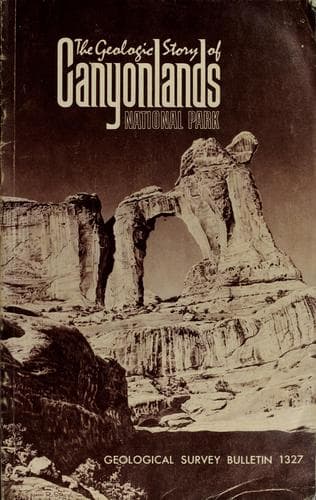
The Geologic Story of Canyonlands National ParkLohman, Stanley William
Science
The Geologic Story of Canyonlands National Park
Lohman, Stanley William
Canyonlands National Park (Utah) -- Guidebooks; Geology -- Utah -- Canyonlands National Park -- Guidebooks
The remaining 10 miles or so of Cataract Canyon within Canyonlands
National Park contains many rapids and should be traversed only under
the leadership of experienced river guides. If and when Lake Powell
reaches its maximum level, it will extend to within about a mile of the
park, but at present (1973) it heads near the mouth of Gypsum Canyon,
about 5 miles below the park.
[Illustration: GYPSUM PLUG of Paradox Member, intruded along south
end of Meander anticline at mouth of Lower Red Lake Canyon. Common
salt has been removed by solution, leaving residue of gypsum and
some shale. Photograph by Donald L. Baars. (Fig. 79)]
[Illustration: Petroglyph]
[Illustration: GEOLOGIC TIME SPIRAL, showing the sequence, names,
and ages of the geologic eras, periods, and epochs, and the
evolution of plant and animal life on land and in the sea. The
primitive animals that evolved in the sea during the vast
Precambrian Era left few traces in the rocks because they had not
developed hard parts such as shells, but hard shells or skeletal
parts became abundant during and after the Paleozoic Era. (Fig. 80)]
The Age of the Earth
The Earth is very old—four and a half billion years or more according to
recent estimates. Most of the evidence for an ancient Earth is contained
in the rocks that form the Earth’s crust. The rock layers
themselves—like pages in a long and complicated History—record the
surface-shaping events of the past, and buried within them are traces of
life—the plants and animals that evolved from organic structures that
existed perhaps three billion years ago.
Also contained in rocks once molten are radioactive elements whose
isotopes provide earth scientists with an atomic clock. Within these
rocks, “parent” isotopes decay at a predictable rate to form “daughter”
isotopes. By determining the relative amounts of parent and daughter
isotopes, the age of these rocks can be calculated.
Thus the results of studies of rock layers (stratigraphy), and of the
progressive development of life (paleontology), coupled with the ages of
certain rocks as measured by atomic clocks (geochronology), attest to a
very old Earth!
Summary of Geologic History
Public-domain text, read in full here on John Shaqi.
Reviews
Reviews
No reviews yet
Be the first to share your thoughts on this work.
Elsewhere in the archive
Join the Discussion
Join the discussion
Sign in to leave a comment or review.
Sign InorCreate an account