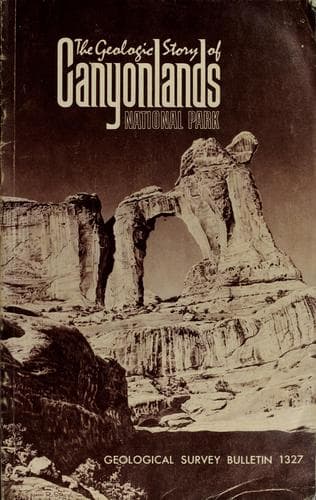
The Geologic Story of Canyonlands National ParkLohman, Stanley William
Science
The Geologic Story of Canyonlands National Park
Lohman, Stanley William
Canyonlands National Park (Utah) -- Guidebooks; Geology -- Utah -- Canyonlands National Park -- Guidebooks
Having finished our geologic ramble through Canyonlands National Park,
let us see how this pile of eroded rocks fit into the bigger scheme of
things—the geologic age and events of the earth as a whole, as depicted
in figure 80. As shown in figure 9, the rock strata still preserved in
the park range in age from Pennsylvanian to Jurassic, or from about 300
to 175 million years ago, a span of about 125 million years. This seems
an incredibly long time, until you note that the earth is some 4.5
billion years old and that our rock pile is but one twenty-fifth, or 4
percent, of the age of the earth as a whole. Thus, in figure 80 the
rocks exposed in the park occupy only about the left-hand third of the
top whorl of the spiral.
But this is not the whole story. As indicated earlier, about 10,000 feet
of younger Mesozoic and Tertiary rocks that once covered the area have
been carried away by erosion, and if we include these, the span is
increased to about 250 million years, or nearly a full whorl of the
spiral.
Deep tests for oil and gas tell us that much older rocks underlie the
area, and we have seen that some of these rocks played a part in shaping
the park we see today—note the breaks in the deep-seated Precambrian
rocks and the salt in the Paradox Member. In addition to the Precambrian
igneous and metamorphic rocks, there are about 2,000 feet of Paleozoic
sedimentary rocks older than the Pennsylvanian Paradox Member. Most of
these sedimentary rocks were laid down in ancient seas during Cambrian,
Ordovician, Devonian, Mississippian, and Pennsylvanian times (fig. 80).
There are some gaps in the rock record caused by temporary emergence of
the land above sea level and erosion of the land surface before the land
again subsided below sea level so that deposition could resume. Silurian
rocks are absent altogether, presumably because here the Silurian Period
was dominated by erosion rather than deposition.
Public-domain text, read in full here on John Shaqi.
Reviews
Reviews
No reviews yet
Be the first to share your thoughts on this work.
Elsewhere in the archive
Join the Discussion
Join the discussion
Sign in to leave a comment or review.
Sign InorCreate an account