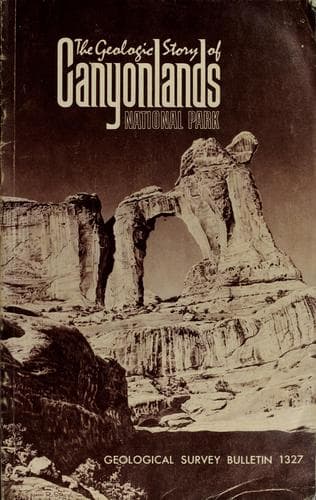
The Geologic Story of Canyonlands National ParkLohman, Stanley William
Science
The Geologic Story of Canyonlands National Park
Lohman, Stanley William
Canyonlands National Park (Utah) -- Guidebooks; Geology -- Utah -- Canyonlands National Park -- Guidebooks
Much of the course of the Colorado River was established in the Miocene
Epoch, with some additional adjustments in the late Pliocene and early
Pleistocene Epochs (Hunt, 1969, p. 67). Erosion during much of the
Tertiary Period and all of the Quaternary Period, combined with some
sagging and breaking of the crust brought on by solution and lateral
squeezing of salt beds beneath The Needles, The Grabens, and the Meander
anticline, produced the landscape as we now see it.
The Precambrian rocks beneath the area are about 1.5 billion years old,
so an enormous span of time is represented by the rocks and events in
and beneath Canyonlands National Park.
If we consider the geologic formations that make up the Colorado
Plateau—including national parks (N.P.), national monuments (N.M.)
(excluding small historical or archeological ones), Monument Valley, San
Rafael Swell, and Glen Canyon National Recreation Area—certain
formations or groups of formations play starring roles in some parks or
monuments, some play supporting roles, and in a few places the entire
cast of rocks gets about equal billing. Let us compare them and see how
and where they fit into the geologic time spiral (fig. 80).
Dinosaur N. M., with exposed rocks ranging in age from Precambrian to
Cretaceous, represents the greatest time span (nearly 2 billion years)
but has one unit—the Jurassic Morrison Formation—in the starring role,
for this unit contains the many dinosaur fossils that give the monument
its name and fame; several older units have supporting roles. Grand
Canyon N. P. and N. M. are next, with rocks from Precambrian through
Permian (excluding the Quaternary lava flows in the N. M.), but here
there is truly a team effort, for the entire cast gets about equal
billing. Canyonlands N. P. stands third in size of cast, with rocks
ranging from Pennsylvanian to Jurassic, but we would have to give top
billing to the Permian Cedar Mesa Sandstone Member of the Cutler
Formation, from which The Needles, The Grabens, and most of the arches
were sculptured; the Triassic Wingate Sandstone and Kayenta Formation
get second billing for their roles in forming and preserving Island in
the Sky and other high mesas.
Now let us consider those with only one or few players in the cast,
beginning at the bottom of the time spiral. Black Canyon of the Gunnison
N. M., cut entirely in rocks of early Precambrian age (except for only a
veneer of much younger rocks), obviously has but one star in its cast.
Colorado N. M. contains rocks ranging from Precambrian to
Cretaceous—equal to Dinosaur in this respect—but it is unique in that
all the rocks of the long Paleozoic Era and some others are missing from
the cast; of those that remain, the Triassic Wingate and Kayenta are the
stars, with strong support from the Jurassic Entrada Sandstone.
Public-domain text, read in full here on John Shaqi.
Reviews
Reviews
No reviews yet
Be the first to share your thoughts on this work.
Elsewhere in the archive
Join the Discussion
Join the discussion
Sign in to leave a comment or review.
Sign InorCreate an account