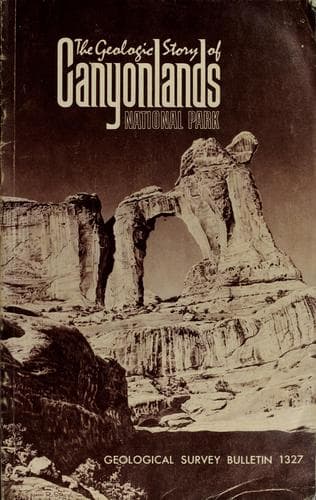
The Geologic Story of Canyonlands National ParkLohman, Stanley William
Science
The Geologic Story of Canyonlands National Park
Lohman, Stanley William
Canyonlands National Park (Utah) -- Guidebooks; Geology -- Utah -- Canyonlands National Park -- Guidebooks
All the bridges in Natural Bridges N. M. were carved from the Permian
Cedar Mesa Sandstone, also the star in Canyonlands N. P. In Canyon de
Chelly (pronounced “dee shay”) N. M. and Monument Valley (neither N. P.
nor N. M., as it is owned and administered by the Navajo Tribe), the de
Chelly Sandstone Member of the Cutler Formation—a Permian member younger
than the Cedar Mesa—plays the starring role.
Wupatki N. M., near Flagstaff, Ariz., stars the Triassic Moenkopi
Formation. Petrified Forest N. P. (which now includes part of the
Painted Desert) also has but one star—the Triassic Chinle Formation,
with its many petrified logs and stumps of ancient trees. The
Triassic-Jurassic Glen Canyon Group (fig. 9), which includes the
Triassic Wingate Sandstone and Kayenta Formation and the
Triassic-Jurassic Navajo Sandstone, receives top billing in recently
enlarged Capitol Reef N. P., but the Triassic Moenkopi and Chinle
Formations enjoy supporting roles.
The Triassic-Jurassic Navajo Sandstone, erosional remnants of which are
found on the high mesas of Canyonlands N. P., is the undisputed star of
Zion N. P., Rainbow Bridge N. M., and Glen Canyon National Recreation
Area, despite the fact that the latter is the type locality of the
entire Glen Canyon Group (fig. 9). The Navajo also forms the impressive
reef at the eastern edge of the beautiful San Rafael Swell (a dome, or
closed anticline, fig. 7), now crossed by Highway I-70 between Green
River and Fremont Junction, Utah.
As we journey upward in the time spiral (fig. 80), we come to the
Jurassic Entrada Sandstone, which stars in Arches N. P., with help from
the underlying Navajo Sandstone and a supporting cast of both older and
younger rocks. The Entrada also forms the grotesque erosional forms
called “hoodoos and goblins” in Goblin Valley State Park, north of
Hanksville, Utah.
Moving ever upward in the spiral, we come to the Cretaceous—the age of
the starring Mesaverde Group, whose caves in Mesa Verde N. P. now house
beautifully preserved ruins once occupied by the Anasazi, the same
ancient people who once dwelt in Canyonlands N. P.
This brings us up to the Tertiary Period, during the early part of which
the pink limestones and shales of the Paleocene and Eocene Wasatch
Formation were laid down in inland basins. Beautifully sculptured
cliffs, pinnacles, and caves of the Wasatch star in Bryce Canyon N. P.
and nearby Cedar Breaks N. M. This concludes our climb up the time
spiral, except for Quaternary volcanoes and some older volcanic features
at Sunset Crater N. M., near Flagstaff, Ariz.
Thus, one way or another, many geologic units that formed during the
last couple of billion years have performed on the stage of the Colorado
Plateau and, hamlike, still lurk in the wings eagerly awaiting your
applause to recall them to the footlights. Don’t let them down—visit and
enjoy the national parks and monuments of the Plateau, for they probably
are the greatest collection of scenic wonderlands in the world.
Public-domain text, read in full here on John Shaqi.
Reviews
Reviews
No reviews yet
Be the first to share your thoughts on this work.
Elsewhere in the archive
Join the Discussion
Join the discussion
Sign in to leave a comment or review.
Sign InorCreate an account