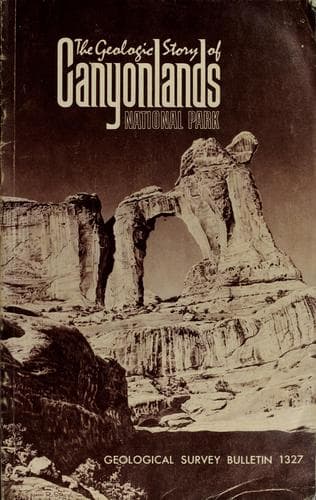
The Geologic Story of Canyonlands National Park — John Shaqi
The Geologic Story of Canyonlands National ParkLohman, Stanley William
Science
The Geologic Story of Canyonlands National Park
Lohman, Stanley William
Canyonlands National Park (Utah) -- Guidebooks; Geology -- Utah -- Canyonlands National Park -- Guidebooks
On June 26, 1969, state and local officials met along the Green River at
the mouth of Split Mountain Canyon, in Dinosaur National Monument, to
dedicate a monument to Major Powell, commemorating the 100th anniversary
of his first river trip, and to dedicate the Powell Centennial Scenic
Drive, also known as the Powell Memorial Highway. In the absence of any
roads closely paralleling the Green and Colorado Rivers except for short
distances, this route is virtually the only means of approach to the
rivers and comprises parts of several state and federal highways
connecting Green River, Wyo., and Grand Canyon, Ariz. A segment of it,
U.S. Highway 163, connects Crescent Junction, Moab, Monticello, and
Blanding, all in Utah, and provides the principal access routes to
Canyonlands and Arches National Parks and Natural Bridges National
Monument.
The ceremonies at the mouth of Split Mountain Canyon began with the
landing of the official party flotilla of four boats similar to the ones
used 100 years earlier by Powell, who was impersonated by a bearded man
dressed to resemble the one-armed major. After the dedication, the four
boats resumed the voyage down the Green River for another ceremony.
On June 29 a second monument was dedicated at the head of Desolation
Canyon, some 50 miles southwest of Vernal, Utah, where the 1869 Powell
expedition first ventured into the then unknown wilderness. The bronze
plaque identifies Desolation Canyon, named by Powell, as a national
historic landmark that comprises 58,000 acres in an area 1 mile wide on
each side of a 95-mile reach of the Green River.
[Illustration: Petroglyph]
Early History
Prehistoric people
There is abundant evidence that the canyon lands were inhabited by cliff
dwellers centuries before the explorations of Powell or the earlier
visits of the Spanish explorers and the fur trappers. Projectile points
and other artifacts found in the nearby La Sal and Abajo Mountains
indicate occupation by aborigines from about 3,000-2,000 B.C. to about 1
A.D. (Hunt, 1956).
Archeologists have found evidence of two occupations by prehistoric
peoples in and near Canyonlands National Park—the Fremont people around
850 or 900 A.D. and the Pueblo or Anasazi people from about 1075 to
their departure in the late 12th century (Jennings, 1970). Within the
park, the most densely populated area was along Salt Canyon and its
tributaries in the Needles district, but many prehistoric dwellings and
granaries are also found just south of the park in Beef Basin and Ruin
Park.
Public-domain text, read in full here on John Shaqi.
Reviews
Reviews
No reviews yet
Be the first to share your thoughts on this work.
Join the Discussion
Join the discussion
Sign in to leave a comment or review.
Sign InorCreate an account